Pressure Points: The signals shaping your next decision

Welcome to Pressure Points
Pressure Points is an executive briefing by Foresight Factory that unlocks the strategic implications hidden inside today’s headlines.
Looking across economics, market shifts, demand signals, supply chains and regulation, we help leaders see where current events are redrawing tomorrow’s competitive landscape. Identify where exposure is growing, which assumptions are breaking and what demands attention now, before it escalates into operational risk or a missed opportunity.
In our first edition we explore questions like:
Will your pension unwittingly inherit governance risk from SpaceX – and will employees even care?
Is your organization mis-timing price rises in a permacrisis world?
Is nearshoring a cost burden or a brand advantage? And what happens when your future consumers disappear from view entirely?
1. The passive investing system is turning pensions into risk bets.
What happened
Index providers Nasdaq, MSCI and Russell changed their inclusion rules ahead of SpaceX’s $86 billion IPO, making the company eligible for inclusion in major benchmarks sooner than the previous rules. This automatically exposed many pension savers globally to SpaceX, and it’s sparking some backlash among those concerned about market volatility, widening inequality and the uncertainty of the AI boom. Others have pointed out that Elon Musk holds more than 80% of the voting power – giving him effective control over major corporate decisions.
The rule changes could affect the treatment of future large IPOs, including those from OpenAI and Anthropic later this year.
Our POV
The SpaceX IPO raises two distinct concerns for leaders. The first is ethical: index rule changes have embedded governance trade-offs at the infrastructure level of capital markets, bypassing the ESG and responsible investment frameworks many organizations have publicly committed to. But our data suggests this may not be the bigger risk: only 10% of consumers believe taking a stand on social issues is an important role for companies to play, and Musk’s divisive public persona is unlikely to trigger meaningful employee backlash on its own (source: Foresight Factory, 2025).
The sharper concern is financial: with financial hardship having surpassed climate change as the top consumer worry in recent years, employees discovering their retirement savings are structurally tied to a single founder’s unchecked decision-making, with no exit route, is a conversation leaders need to get ahead of.

Now what?
Audit your institutional exposure before employees or the board raises the question. As the next wave of founder-controlled megacompany IPOs arrives, having a defined position on governance exceptions in passive holdings is no longer optional.
2. Gen Alpha is going dark as governments restrict social media access
What happened
The UK government plans to ban under-16s from major social media platforms like TikTok, Instagram and Snapchat from 2027, part of a broader push to restrict youth access to potentially harmful digital environments. While the ban’s primary champion, Keir Starmer, has since announced he will be resigning as prime minister, the Department for Culture, Media and Sport maintains the legislation will proceed.
Our POV
Early evidence from Australia, which introduced a similar ban in late 2025, suggests young people quickly find workarounds, from VPNs to secondary accounts. Nevertheless, regulation changes the operating environment for brands, and makes younger consumers harder to observe, measure and reach at scale.
This matters because Gen Alpha has become a critical commercial target. The cohort is estimated to number 2 billion globally and is responsible for $100 billion in direct annual spending, alongside significant influence over household purchases. At the same time, brands have spent the past decade concentrating spend into the very channels now becoming politically vulnerable, with UK social media ad spend reaching £11.5 billion (c. $15.2 billion) in 2025, up 21% year-on-year, and gaming ad spend rising by 11% to £1.3 billion (c. $1.7 billion).
Now what?
Act now to stress test alternative strategies and avoid reactive pivots further down the line. It goes without saying that attracting the attention of Gen Alpha as their preferences form is crucial for the future health of brands. Those logos not agile enough in recalibrating their approach in the face of social media restrictions stand to lose revenue and equity among the biggest generation ever.
3. Companies must be prepared to defend delayed inflation effects
What happened
The agreement signed by the US and Iran on June 15th to end the conflict between the two nations and pave the way for the reopening of the Strait of Hormuz led to a drop in the price of oil and a rally of global stock markets.
However, inflation is expected to rise before it normalizes, as the effects of higher fuel costs on other sectors begin to be felt further down the line. For instance, the Food and Drink Federation has warned that food inflation in the UK will reach 9 or 10% by the end of 2026. Our partners at Oxford Economics believe that CPI inflation will peak at around 3.5% in the UK in late 2026. There is also a political angle to the inflation story in the US, with the cost of living likely to be a key feature of the midterm elections in November.
Our POV
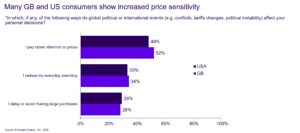
Many companies have so far absorbed rising energy and raw materials costs rather than pass them on to squeezed customers, though this is not viable in the long run. If brands raise prices later in the year, when the Iran conflict is potentially a distant memory, it could expose them to criticism from consumers, including accusations of price gouging or profiteering. Many shoppers have an exaggerated view of the profit margins enjoyed by brands. And our data shows that around 1 in 2 Americans and Brits say they pay closer attention to prices as a result of international events such as conflicts.
Now what?
Be open and transparent with customers now to avoid reputational risk down the line. US sexual health and wellness brand Dame was praised for its honesty when it added a $5 surcharge to all purchases in response to tariffs levied by President Trump, and the brand gained further kudos when it later refunded those customers affected. Meanwhile, following the Iran crisis, Brittany Ferries made a firm pledge not to raise prices or cancel services for the rest of the year, pointing out that it was able to do this thanks to its fuel hedging strategy. They did, however, subsequently announce they would be removing some routes due to financial pressure, underlining the difficulty of keeping such a pledge. To win and retain consumer trust, clearly explain why price rises might be necessary, but that you are doing all you can to minimize the impact – and make sure you can follow through on whatever promises you make.
4. Nearshoring could raise exposure to costly cyber-attacks
What happened
Online security experts Teiss have warned against relying on nearshoring alone to mitigate supply chain risk. They make the point that while physical risks to logistics are top of mind, there is also a layer of digital exposure – in the form of cyber-attacks – that is not receiving the same attention. This adds yet another nuance to a decision that brands – particularly those with strong brand heritage – have long struggled with; whether to nearshore or offshore production. And in a polarized world beset by geopolitical tensions and evolving tariff policies, this concern is gaining traction in new markets and areas.
Our POV
There is a danger that nearshoring is seen as a guaranteed way to reduce exposure to a range of risks, but moving production geographically closer to home can offer a false sense of security. For instance, as Teiss point out, nearshoring can involve switching to new suppliers who may not have undergone the same scrutiny as trusted existing partners.
Some of the advantages of local production may also be overstated. While some consumers advocate supporting local businesses in theory, the phenomenal growth of brands like Temu and Shein shows that for many, low cost and value are primary drivers that override ethical or value-based considerations, especially when incomes are squeezed.
Now what?
Subject your current or future nearshoring plans to renewed scrutiny, to avoid exposure to business risks. Don’t allow headlines about the impact of geopolitical instability on supply chains to derail your commitment to due diligence when it comes to switching suppliers. With one estimate putting the global financial impact of cyber-attacks at $15 trillion by 2029, it could prove a costly mistake.
5. The solo economy is a lucrative market waiting to be served
What happened
So-called “loneliness influencers” are amassing significant followings on social platforms by documenting their solitary, child-free and friendless lives, and framing them as an aspirational, deliberate choice. One example is @itspaulinacee, who has more than 300k followers on Instagram and writes in her bio: “nyc with no friends and no complaints”, using hashtags like #cozyathome, #introvertdiaries, and #alonenotlonely.
View this post on Instagram
Our POV
Social signals like this are easy to miss since they show up in lifestyle content rather than business media – but the structural shift underneath this one is already affecting category demand.
Single-person households accounted for a fifth of all households worldwide in 2023, and they are forecast to reach a quarter of households by 2040, growing in number by 48% and outpacing every other household type. While solitary behaviors are often lamented as a societal problem that needs fixing, the smarter read is that this is a demographic shift that’s becoming entrenched. Consumers are actively constructing their identity around preferring to opt out. Meanwhile, brands that have built loyalty mechanics, product formats and occasion frameworks around the assumption of shared households are already leaving money on the table – and the gap widens with every year this segment grows.
Now what?
Audit your product portfolio for solo use. McDonald’s recently won praise in China for its partitioned single-person tables – responding directly to a consumption shift through physical infrastructure change. The brands that win this segment will redesign the experience or product entirely, not just the campaign.