More and more consumers are using their smartphones and wearable devices to track their behavior, optimize their performance and build healthier habits. But within this broader quantification movement, a distinct tribe has emerged: the Health Hyperquantifiers.
These are consumers who don’t just dip into self-monitoring – they go deep. This piece draws on Foresight Factory’s proprietary consumer research to profile the tribe, explore how they vary across global markets and unpack what they want from the brands that serve them.
Who are the Health Hyperquantifiers?
We define Health Hyperquantifiers consumers who track four or more of the following via their smartphone or another device: calorie or fat intake, alcohol consumption, vital health signs such as blood pressure or heart rate, calories burnt when exercising, performance and distance covered when exercising, sleep patterns, mood and screen time.
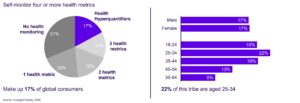 17% of global consumers fall into this tribe, up from 12% in 2019 across 24 consistently surveyed markets. It is a younger tribe, accounting for around 1 in 5 consumers aged 25-34, and the tribe is equally represented by women and men.
The broader context is just as significant. 31% of global consumers currently don’t monitor any health metrics at all. This is down from 43% in 2019, meaning a clear majority of consumers are now doing some level of self-quantification.
Older consumers are significantly more likely to monitor nothing at all, including half of 55-64s. Meanwhile, 16-24s are more likely to track just one metric, and among those who track a single metric, it is most likely to be screen time.
How do Health Hyperquantifiers differ by market?
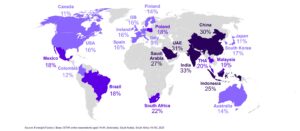
Health Hyperquantifiers are most likely to be found in Asia and the Middle East. The tribe is most prominent in India (33%), the UAE (31%) and China (30%). In Europe, the highest proportion of Health Hyperquantifiers is found in Poland at 18%. The tribe is smallest in Italy (9%), the Netherlands (10%), France (10%) and Canada (11%).
What are their behaviors and how can brands connect with them?
1. They are highly engaged with sports and fitness
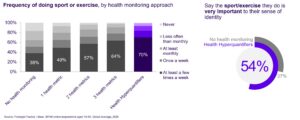
70% of Health Hyperquantifiers exercise at least a few times a week, compared with 38% of those who don’t self-monitor any health metrics. This is unsurprising given that performance and distance covered while exercising is the most popular metric to track among this audience, with 82% doing so.
Health Hyperquantifiers are also significantly more likely to feel that the sport and exercise they do is important to their identity: there is a 27-percentage-point difference in agreement levels between this audience and those who don’t monitor any health metrics.
How should health and wellness brands act?
Turn performance into a personalized achievement loop. Health Hyperquantifiers work out frequently and track their performance intensively. To win with them, create feedback-rich ecosystems that marry their activity with their desire to track: adaptive training plans, dynamic performance scoring, personalized milestones or exclusive rewards unlocked through verified activity. An example of this kind of offering is the BodyPark ATOM, an AI fitness device that delivers instant feedback, post-workout analytics and goal-oriented bespoke training plans.
2. They want to optimize their gear
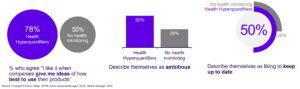
Health Hyperquantifiers are keen to know how to make the most of product features, and there are real opportunities for brands to act as educator brands that help them upskill. Since they are more likely to purchase technical hardware and gear, such as wearable devices and premium workout clothing, they expect their investments to work hard for them.
This audience is also more driven than average: 50% describe themselves as ambitious vs. 29% of the global population. And they want to know the latest trends and have access to the newest offers.
How should health and wellness brands act?
Position your brand as a coach, not just a facilitator. Build an educational layer around your products that shows Health Hyperquantifiers how to squeeze every drop of value from their investment. This could include videos and in-app tips that walk-through product features and upgrades, on-demand clinics with product specialists detailing how functionality can improve pace, recovery or form, and playbooks that match users’ goals with specific product features.
Consider also developing loyalty programs tied to engagement and activity rather than spend, to fast-track loyal users and early adopters and offer them early access to new features and product drops.
3. They are aesthetically minded
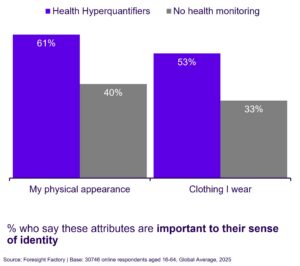
61% of Health Hyperquantifiers see their physical appearance as important to their identity, and 53% feel the same way about the clothes they wear, both notably above the average consumer and those who track fewer health metrics. This suggests that the desire for wellness and performance data is, at least in part, connected to the desire to improve their appearance.
Since Health Hyperquantifiers exercise frequently, looking good while playing and competing is also important. Creators such as @sabriinab___ (over 267k followers on Instagram), who documents her hiking outfits, and @jennalitner (over 95k followers on Instagram), whose “your workout outfit looks like sh*t” series helps fitness enthusiasts’ level up their look for performance, are tapping into a growing desire to look good while working out. This is especially the case on race and competition days, when consumers, influencers and athletes create GRWM content to show off their outfits and accessories.
@femaria It’s finally race day!!! #tokyomarathon #marathon #runner #raceday ♬ original sound – Jordan
Brands are responding. Performance sock brand Swiftwick created a nostalgic range of merch in collaboration with Cole Townsend from the Running Supply newsletter for the Boston Marathon, while running apparel brand Bandit created an NYC marathon pop-up described as “pure fashion.” Meanwhile luxury fashion house Louis Vuitton has become the official partner of Formula 1, reflecting growing fashion industry interest in sports across categories.
How should beauty and personal care brands act?
Create products, techniques and routines that go the distance. Develop sweatproof, long-lasting and transfer resistant formulas, and share application techniques designed specifically for daily workouts, competitive events and outdoor training. Brands are already showing up in relevant spaces here. For example, beauty retailer Mecca became the Official Beauty Partner of the 2026 Australian Open, with 13 SPF touchpoints across the venue. But consumers want to go beyond functional offerings here. Playful looks for competitions and races are becoming more popular too, such as nail art to match shoes or outfits and glitter freckles from brands such as Fazit. Brands can show consumers how products can be incorporated into race-day, and how to make them last from warmup to cooldown, tapping into how looking good can boost both confidence and performance.
4. They are adventure-seeking on vacation
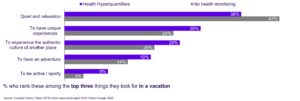
Health Hyperquantifiers are significantly more likely to rank having unique and cultural experiences and adventures among the top three things they look for in a vacation compared to those who do not monitor their health. The proportion seeking quiet and relaxation on vacation is 9 percentage points lower than among those who don’t monitor any health metrics. This indicates that while this audience isn’t necessarily looking to maintain everyday sports and fitness habits while on holiday, they see time off as a chance to be adventurous, to experience new things rather than simply recharge.
How should travel and tourism brands act?
Turn your brand into their adventure concierge. Across categories, create services, content and partnerships that help Health Hyperquantifiers plan and unlock memorable activities at their destination. Build and market trips around new experiences and mini adventures rather than access to a standard gym or wellness facilities.
These can aim to push travelers’ boundaries, such as Fit2Flaunt’s Colombian exotic pole dance and flow retreat, or deliver opportunities to try a familiar sport in new locations, taking inspiration from Strava and Airbnb’s partnership spotlighting run-cations. The message: your brand is the one that helps them use their time off to push boundaries.
Understand your highest-value health consumers with Collision, Foresight Factory’s dynamic foresight intelligence platform.
The Health Hyperquantifiers are a well-defined, commercially significant audience, and knowing they exist is only the starting point. The challenge for brands is understanding how this tribe is evolving, what they are responding to and where the opportunity is moving within your specific category and markets.
Collision, Foresight Factory’s dynamic foresight intelligence platform, is built for exactly this. Through custom audience frameworks and segmentation tools, Collision tracks consumer behavior across 27 markets with 200+ demographic breaks, giving brands a continuously updated view of how high-engagement audiences like Health Hyperquantifiers are shifting.
With live momentum metrics, maturity and velocity scores, and personalized dashboards configured to your strategic priorities, Collision moves brands from awareness of a trend to confident, evidence-backed decisions about when and where to act.
While other platforms give you data, Collision gives you direction. Speak to us about booking a demo and see how Collision can bring audiences like the Health Hyperquantifiers to life for your brand. Book a demo or get in touch at hello@foresightfactory.co.