How is climate change making net-zero goals more difficult to achieve? Why are consumer concerns about privacy becoming more prominent? And what does a Gen Z protest in India mean for how brands should speak to younger consumers?
Below is Foresight Factory’s August 2026 cultural signal scan: three cultural and consumer trends on our radar this month and their impact on people. By scanning the headlines, keeping tabs on social media conversations and tuning into the zeitgeist, we connect the dots between our trends and the wider world, so you can make sense of what’s happening now and what it means for you.
Key insights
- Memes and internet humor are a language of political dissent for Gen Z. In India, a satirical collective called the Cockroach Janta Party (CJP) has become a focal point for youth-led protests over education, unemployment and corruption. Protesters posted “get ready with me” videos before marches and synced footage of police clashes to viral meme formats.
- Efforts to reach net zero are proving more contradictory than expected, deepening the risk of consumer apathy. In mid-July, Britain’s biggest community solar farm was forced offline for the summer after officials flagged a risk of grid overload, an outage expected to cost the cooperative around £2 million (c. $2.6 million). Meanwhile, 3 in 10 consumers believe it is already too late to counter the effects of climate change (source: Foresight Factory, 2026).
- Surveillance is moving from the background of digital life into the foreground of consumer culture. Meta Glasses, which can record people in public relatively covertly, have sparked a backlash serious enough that some owners have stopped using them. Data privacy concerns are now the top reason global consumers give for not using generative AI, cited by 31% (source: Foresight Factory, 2026).
1. The surveillance economy: Why privacy is becoming premium

Everyday surveillance is becoming normalized
Surveillance is moving from the background of digital life into the foreground of consumer culture. Cameras and sensors are no longer confined to obvious security contexts – they are increasingly embedded in everyday products like AI glasses, smart doorbells and autonomous vehicles. These products are often justified through convenience, safety or accessibility benefits. Yet collectively, they are creating an environment in which recording becomes an ordinary feature of daily life, often without clear consent.
Meta Glasses, launched in June 2026, have become a flashpoint. They integrate smartphone technology into standard-looking glasses and sunglasses, giving them the ability to record people in public relatively covertly. While the glasses have a recording indicator (a flashing light on the frames), reports claim that some people have been hiding or removing this to secretly film – leading Meta to release an update that disables the camera if tampering is detected.
The backlash to the glasses – rechristened “pervert glasses” – has been swift, with some owners stopping using them as a result. Organizations like the Good Law Project have raised concerns about the potential risks of the glasses to the safety of women and children, describing them as a “surveillance nightmare for women”. There are also indications that the glasses have been used to monitor student protestors at Jantar Mantar in India. (We have covered the protest and its impact more extensively in this month’s What’s Trending report here).
The activist group Everyone Hates Elon has launched parody ads for the glasses around London, one featuring Jeffrey Epstein and the slogan “Glasses for people who don’t do consent”. New York has banned the glasses from courtrooms and Meta-owned Instagram has even banned content that is “taking advantage of people and harassing them” filmed with the glasses, though similar content filmed on smartphones has not been addressed.

Similar tensions are seen across other categories. Doorbell cameras promise household security but can also extend monitoring into streets and shared spaces. Amazon’s Ring doorbell Search Party feature is a free tool that allows anyone to report a lost dog through the Ring app and then prompts local cameras to automatically scan for matches. A Super Bowl ad for the feature drew criticism from consumers due to privacy concerns.
The Ring cam lost dog ad is just propaganda for mass surveillance.
— Stephen L. Miller (@redsteeze) February 9, 2026
AI is also a risk factor in ambient surveillance
AI is intensifying privacy concerns through “ambient scrutiny”. Its integration into a wide range of services by default, for example Google Search and customer service interactions, means it is increasingly difficult for consumers to opt out of AI use. And research on large-scale online deanonymization shows how large language models can be used to identify pseudonymous users by connecting clues across posts, profiles and publicly available information. For consumers, this means anonymity online may become harder to maintain, not through any fault of their own, but because AI is better at noticing patterns that were previously too fragmented to exploit.
Data privacy concerns are the top reason given by global consumers for not using generative AI, with 31% giving this as a reason they don’t use it.

Surveillance chic is emerging as a content niche
At the same time, surveillance culture is being aestheticized. The rise of “surveillance selfies” shows consumers and creators turning security footage into a visual language of its own. The likes of doorbell cameras and self-checkout screens are being used to create shareable fit checks and candid selfies.
For some creators, this is a form of agency and self-awareness about monitoring. Ruby Lin, a New York designer, shares OOTDs (outfit of the day images) from her Ring camera with tongue-in-cheek captions addressing her “assigned FBI watcher” and has said she was “commenting on the fact that we’re all kind of being watched anyway”. However, others see it differently. Judith Donath is an artist, computer scientist and a fellow at Harvard University’s Berkman Klein Center for Internet & Society who feels that surveillance selfies don’t necessarily engage with the darker sides of this technology and they can be “about a complicity in putting a happy face on a surveillance culture”. This kind of content can potentially normalize constant surveillance and even make it appear aspirational.
Dashcams show a related dynamic. They are being used to generate content, with captured moments going viral and some creators even intentionally manufacturing incidents to share on social media.
View this post on Instagram
The surveillance backlash is boosting NPD
Concerns around constant monitoring are driving a wave of innovation to align with consumers who wish to opt out of omnipresent surveillance. From period-tracking apps that minimize data exposure to telecoms providers that position around privacy, brands are beginning to treat data protection as a feature rather than a legal footnote.

Anti-surveillance fashion and accessories deliver similar benefits. Solir Optics and A-Morir offer anti-facial recognition glasses. Urban Privacy creates apparel and accessories that help consumers protect their personal data and identities. For example, an anti-tracking smartphone bag blocks tracking and location sharing to allow people to move in private, while other styles confuse facial recognition systems or block photographs from being taken. Cap_able integrates “AI-interfering patterns” into knitwear. As ambient surveillance expands, consumers may increasingly seek products such as these that help them move through monitored environments on their own terms.
Why it matters
- There is a clear convenience-privacy tension here. Many consumers already use facial recognition, connected devices and AI-enabled tools because they reduce friction. By 2024, 52% of global consumers had used facial recognition tech to verify their identity – the exact same proportion as are interested in wearing privacy glasses that block facial recognition technology from working on them (source: Foresight Factory). Consumers want the benefits of technology without losing agency. The brands that win will be those that make consumers feel most in command of when, how and why they are seen.
- In this context, privacy and intimacy are becoming new status symbols. As consumers tire of being constantly tracked and recorded, unwatched moments and the ability to be unreachable gain value. As privacy becomes aspirational, there is commercial potential in experiences that offer genuine disconnection and moments than cannot be endlessly replayed or analyzed – a form of privileged access.
- There is also an opportunity to reframe AI as a protective, rather than an exploitative tool. Use cases such as helping detect scams, control data sharing or reduce unwanted tracking could turn anxiety about AI surveillance into trust.
2. Solar, satellites and the messy mathematics of net zero

When more solar power becomes a problem
In mid-July, Britain’s biggest community solar farm was forced to shut down for the summer so as not to overload the local grid with renewable energy. The Derril Water solar park in north Devon, backed by nearly 10,000 members, was ordered offline by the National Energy System Operator after officials flagged a risk of “thermal overload” at a nearby substation.
The shutdown is expected to cost the cooperative around £2 million (c. $2.6 million) in lost revenue, with the board blaming outdated grid infrastructure that has failed to keep pace with the rapid growth of renewable generation. With retailers including Lidl now selling home solar systems, similar bottlenecks are likely to become more common.
Cleaner air, hotter summers
Meanwhile, as record heatwaves and wildfires plague Europe, a study published in Geopolitical Research Letters points to a counterintuitive driver: falling air pollution. Researchers from the Barcelona Supercomputing Centre and the UK Met Office found that a decline in sulfate aerosols since the 1980s, a byproduct of clean air policies, has let more sunlight reach the ground and altered atmospheric circulation in ways that trap heat over the continent.
Scientists have pushed back against headlines asserting that declining air pollution “caused” the continent’s heatwaves, but they agree the effect is real: cleaner air has altered weather patterns, amplifying summer heat. This is an effect that most climate models neglect to consider, a gap that exposes how underprepared society is for the green transition’s second-order effects.
Mirrors in space, uncertainty on the ground
And in the US, the FCC has granted California startup Reflect Orbital a license to launch a mirror satellite into space that would reflect sunlight to illuminate parts of the Earth at night. One use case cited on its website is to “extend the utility of sunlight … to help make existing solar infrastructure more useful beyond the hours when direct sunlight is available”. Critics argue, however, that it would increase light pollution, disrupting wildlife and ecosystems that depend on natural cycles of light and darkness. A gain for one part of the sustainability picture comes at the expense of another. One key takeaway from these examples is that sustainability is complex. Structural change is needed, but the decisions made in pursuit of it can be counterproductive. And conflicting stories risk deepening consumer apathy at a time when 3 in 10 consumers believe it is too late to counter the effects of climate change (source: Foresight Factory, 2026).

Why it matters
The road to net zero is not straightforward. It doesn’t just require innovation, but whole-system adaptation, meaning that industries need to work together to ensure that energy generation, infrastructure and demand line up. Moreover, to secure consumer buy-in, brands and institutions backing these initiatives need to make sure they are sustainable, convenient and cost-effective – as well as connected to infrastructure that can actually support them.
3. Gen Z protest core: Memes, satire & humor fuel India’s youth uprising
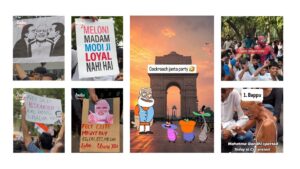
A satirical party leads India’s Gen Z movement
What does a protest led by Gen Z look like? In India, it’s increasingly unserious and takes the form of a meme.
In June 2026, the Indian government announced its decision to make more than two million students retake a highly competitive medical entrance exam after paper leaks. In the aftermath – during which twenty candidates had taken their own lives over the prospect of going through the entire ordeal again – thousands of young Indians took to the streets to protest against an education system long criticized as harsh and outdated. What began as a demonstration against the paper leaks, turned into a nationwide protest against the government, unemployment, corruption, education and failing institutions after the police used force against peaceful protestors, ultimately leading to the resignation of the education minister.
That the protests were driven by the Cockroach Janta Party (CJP), a satirical internet collective playing on the name of the ruling Bharatiya Janata Party (BJP), speaks to the increasingly blurred lines between meme culture and political dissent. The CJP emerged after the Chief Justice of India referred to unemployed youth as “cockroaches” and “parasites”, turning an insult into a badge of defiance. What began as satire became a focal point for wider frustrations among young Indians, demonstrating how internet humor can lead to real-world mobilization.
Memes are a language of political dissent for Gen Z
View this post on Instagram
 This blurring of lines between memes and activism was on full display during the June protests, when Indian Gen Z turned to internet slang and popular social media formats to express dissent.
Across social media, young Indians were seen posting “get ready with me” videos before marches and shared “fit checks” showing off homemade protective gear like helmets and goggles. When clashes with police broke out, protesters joked about fleeing officers to keep their Strava streaks alive, while others synced footage of their escape to the theme song of the mobile game Subway Surfers. Parody videos mocked pro-government television anchors who had branded protesters “anti-national” and “foreign funded”, while edits mocking Prime Minister Narendra Modi’s speeches went viral on Instagram Reels.
Protesters also deliberately used unserious language and slogans to mock the government. One woman filmed herself saying: “Today, I’m wearing a spine, some jhumkas and also my constitutional right to protest”. Another reel overlaid footage of protesters with the words “baddies assembled”, while others joked about “getting ready to get beaten up by Delhi police”.
View this post on Instagram
Politicians are learning the language of memes
The influence of meme culture is also moving into mainstream politics. Opposition leader Rahul Gandhi and his party, the Indian National Congress, have increasingly adopted memes and viral formats to communicate with younger audiences. The party’s youth wing reposted a song about the CJP on Instagram with lyrics including “Yes, I am a cockroach, students are dying, but my PM is on silent mode”. It has also shared recent content around “Gen Z protest core”, showing how political parties are beginning to tap into the same internet-native culture shaping youth activism.
Meanwhile, days after the education minister resigned, Gen Z slang such as “delulu” and “FOMO” began appearing in parliamentary discourse.
This reflects a wider shift in political communication: as young people use internet culture to challenge political institutions, political parties are learning to speak back in the same language. Memes, then, are becoming a means for traditional parties to appeal to younger consumers, reaching those who may feel alienated by traditional political language.
Education is a flashpoint for Gen Z disillusionment
The protests also point to a deeper source of frustration among India’s young population: the growing gap between educational aspiration and economic reality.
India is home to one of the world’s largest youth populations, with under-35s making up around 65% of the population. It is also an increasingly educated generation. Between 2007 and 2017, the share of students from the poorest households enrolled in higher education more than doubled, from 8% to 17%. Yet, for many young Indians, education is failing to deliver the economic security it promises, with youth unemployment remaining high.
The exam paper leak marked a turning point, tapping into growing anxieties about whether young people can trust the systems they have been told will secure their futures. In a society like India, where academic success is seen as one of the primary routes to social and economic mobility, failures in the education system has made the youth feel hopeless and disillusioned.
The rise of AI adds another layer of uncertainty. As generative AI reshapes entry-level work and automates tasks traditionally performed by graduates, young people are increasingly questioning what their education is preparing them for in the first place. The promise of a linear trajectory of studying hard and getting a good job is becoming less certain at a time when both employment prospects and the value of traditional systems are being questioned. Many of these issues and concerns are shared by younger people around the world.
Why it matters
- The rise of meme-led political movements highlights the need to understand Gen Z’s language rather than dismiss it as frivolous. The same formats associated primarily with entertainment are increasingly being repurposed to communicate concerns around education, employment, politics and AI. Brands can also tap into these cultural codes to connect with younger consumers, but doing so with authenticity will be critical as misusing the language or adopting internet culture without understanding their context risks alienating younger audiences.
- As trust in institutions declines, humor is becoming a tool for young people to build community, express disillusionment and make their voices heard. In this environment, co-opting Gen Z humor without addressing the underlying frustrations driving it will appear performative and opportunistic. Brands seeking long-term loyalty from younger consumers will need to go beyond adopting the right tone of voice and demonstrate alignment with the values and principles they communicate.
Talk to us about getting access to Collision, our dynamic trends intelligence platform
These August 2026 trends are part of a longer report published on Collision, our dynamic trends intelligence platform. Members get access to these reports at the beginning of every month, so they always have a finger on the pulse of consumers and culture. If you’re interested in learning more about Collision and how the platform can make a difference to your business, get in touch today.

Social media as a catalyst for Gen Z protests
India’s meme-led mobilization is part of a wider pattern of Gen Z political movements, in which social media is becoming both an organizing tool and a space for political expression.
In Nepal, young people took to the streets last year amid anger over corruption and government restrictions on social media, ultimately leading to the resignation of Prime Minister KP Oli. What was notable was how Discord became a space for political discussion and organization. In the Indian context, Telegram was used for organizing, as were WhatsApp and Instagram.
Bangladesh has similarly seen social media become an increasingly important space for organizing dissent. Across these movements, the mode of protest is distinctly Gen Z: internet-native, often deliberately flippant, with memes sitting alongside serious political demands.