What does the rise of loneliness influencers say about consumer aspirations? Why do brands keep getting called out for cultural missteps? And how is extreme heat creating new rituals and consumption behaviors?
Below is our July 2026 cultural signal scan: three cultural and consumer trends on our radar this month and their impact on people. By scanning the headlines, keeping tabs on social media conversations and tuning into the zeitgeist, we connect the dots between our trends and the wider world, so you can make sense of what’s happening now and what it means for you.
Key insights
- Despite plenty of cautionary tales, companies keep getting called out for costly cultural mishaps. Starbucks recently closed all of its stores in South Korea for half a day to conduct staff “social sensitivity” training after its Tank Day tumbler campaign spectacularly backfired. The closure alone is estimated to have cost 2.1 billion won (approximately $1.4 million).
-
“Loneliness influencers” are building massive followings around aloneness as an aspirational lifestyle. On TikTok and Instagram, a growing number of creators are flaunting their solo lives under hashtags like #cozyathome, #introvertdiaries, and #alonenotlonely. One creator, @itspaulinacee, has more than 300k Instagram followers.
-
Extreme heat is shaking up routines and purchasing behaviors. In India, for instance, demand for cold coffee and jeera soda climbed 700% and 900% respectively between March and April 2026. Consumers are also time-shifting: Australian research based on 200 million bank transactions found that on days that reached 35°C or above, daytime spending fell sharply, particularly between midday and 6pm, before rebounding in the evening.
1. Is cancel culture canceled? Brand boycotts in a polarized world

Companies are called out for cultural missteps
In a similar vein, activewear brand Lululemon apologized after a promotional yoga event on the Great Wall of China triggered criticism over the alleged use of a Japanese drum, following a backlash on Chinese social media. Another brand activation that courted controversy was meal kit service HelloFresh’s Pride Month post in the UK. Here, attitudes were more mixed; while some felt the sexualized messaging was too explicit, others were supportive of the frank, taboo-busting stance.
Celebrities are criticized for commercial activity
There have also been some high-profile examples of well-known stars attracting ire for their endorsement of brands. Gwyneth Paltrow came under fire for starring in an advertisement for an Israeli real estate company. This is perhaps not surprising, given how polarizing Israel is and how vocal pro-Palestine activists are. Fellow thespian Timothée Chalamet was also criticized after appearing in an ad for prediction market platform Kalshi – a sector criticized by some as ethically dubious, though its user base has grown explosively.
View this post on Instagram
The impact of brand boycotts must be put in perspective
Analysis of Google searches on the topic of boycotts show that these align closely with high-profile global events. For instance, there was a big spike in November 2023 as brands such as McDonald’s were targeted amid the fallout from the Israel-Hamas war. A subsequent peak in April 2025 aligns with President Trump’s Liberation Day tariffs announcement and calls for US boycotts. While searches have remained elevated since November 2023, it’s notable that spikes related to specific events quickly subside.
Foresight Factory analysis shows that only a minority of American and British consumers have boycotted a brand for any reason, and the most common motivation is excessive price increases. In the US, only 8% had boycotted a brand for appearing to be pro-Israel in the Israel-Palestine conflict, while 11% had done so for appearing to be pro-Palestine. This suggests that Gwyneth Paltrow’s endorsement of Israel may have in fact pleased more Americans than it offended. And while McDonald’s famously took a financial hit from Gaza-related boycotts, the company’s financial position has subsequently recovered.
Why it matters
- It’s striking that, despite plenty of cautionary tales of previous marketing mistakes, and evidence that many consumers are quick to call out unethical companies, brands sometimes still get things wrong and cause offence. One important detail from the Starbucks incident is that an AI tool was reportedly used to generate potential slogans, while managers tasked with signing off the activation had not actually viewed the material themselves. AI may not always understand cultural sensitivities and can generate offensive material. As the technology becomes more widespread, the potential for this kind of incident, which attracts universal criticism and real financial damage, will grow.
- Another consideration is that, in a world of Societal Polarization, more brands and celebrities may realize that it’s not possible to please everyone all the time, and that noisy online protests do not always translate into boycotts. Indeed, ethical considerations are often sacrificed to more pressing concerns of cost and convenience. While principles still matter to many consumers and brands, in a divided world, more may be coming to terms with the idea that taking a stance on ethical issues can make enemies as well as friends.
2. Living with heat: Consumers and brands are adapting to a hotter planet

Extreme heat is moving from distant climate risk to daily consumer disruption
Record-breaking heatwaves, rising humidity and the prospect of a powerful El Niño are making extreme heat a top concern for consumers across the globe. In June 2026, the Met Office reported that El Niño conditions had developed in the tropical Pacific, with Professor Adam Scaife, Head of Long-Range Forecasting, describing the event as “perhaps one of the most intense on record” and warning of severe impacts across multiple regions.
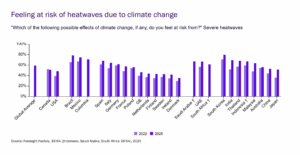 Our data shows that concern about heatwave risk is rising: 58% of global consumers felt at risk from severe heatwaves in 2025, up from 50% in 2022 (source: Foresight Factory, 22-country global average).This is already impacting consumer behavior, and as heat worsens it will continue to affect activity and consumption patterns. A hot day can empty stores, trigger sudden demand for cooling and hydration products and generate health anxiety. A hotter decade, meanwhile, could drive up the cost of everyday goods in a phenomenon known as climateflation, deepening inequalities between those who can adapt and those who can’t.
Consumers are adapting by time-shifting, cooling down and staying hydrated
One behavioral response to extreme heat is time-shifting. Australian research based on 200 million bank transactions found that on days that reached 35°C or higher, daytime spending fell sharply, particularly between midday and 6pm, before rebounding in the evening.
This is one example of how consumers are adapting to a changing climate by moving consumption into cooler windows. Cities and businesses – from retailers to hospitality – that embrace 24-hour economies and design around the impacts of heat with, for example, later opening and shaded pick-up and rest points, will be more climate-resilient.
Another way consumers are coping is by spending within cooling and hydration categories. In the UK, fan sales reportedly surged 2,758% at retailer Currys YOY and 800% at John Lewis over the May bank holiday weekend compared to the previous week. Some consumers are moving towards more permanent solutions, with air-conditioning unit installers claiming to be booked out for the summer. Wearable cooling technologies, such as Sony’s Reon Pocket Pro Plus personal air-conditioning device, hint at a future in which heat management becomes mobile.
Functional drinks for cooling and hydrating are also in demand. Google search activity relating to electrolytes is spiking globally, while in India, demand for cold coffee and jeera soda climbed 700% and 900% respectively between March and April 2026, according to data from quick commerce platform Swiggy Instamart’s Summer 2026 Trends. In China, ice cups remain popular this year as a convenient way for consumers to make iced coffee or cold fruit drinks at their desks or on the go. The packaged cups of ice typically cost between 3 and 10 yuan (US$0.4-1.4) at convenience stores, turning what was a free add-on into a paid treat.
Heat creates economic pressure too
Research indicates that extreme heat could raise global inflation by 0.3 to 1.2 percentage points a year from 2035, with food prices especially exposed. Examples of such climate inflation already exist; for example, tomato prices in Mexico have doubled compared to last year as a result of unseasonal weather including drought, while in India, inflation expectations have been increased for 2027 after high temperatures and reduced rainfall projections for summer 2026.
Insuring homes and businesses against the risks of extreme weather is also a concern. A report from TheCityUK argues that it is becoming more difficult for insurers to price against these costs, which could lead to “protection gaps” and knock-on effects on the financial system as a whole.
Why it matters
- Consumer adaptation to extreme heat will have second- and third-order impacts which will touch brands across all sectors. For example, the Australian research revealed that consumers avoided department stores and shopping centers on hotter days, despite the promise of air conditioning. Consumers already value remote services and interactions, and this will only intensify as temperatures rise. Online shopping as well as remote work, education and childcare arrangements will reduce exposure to dangerous heat. Consumers will also look for permission to slow down: to work, shop, exercise, commute or parent at a different rhythm when heat makes normal productivity feel unrealistic.
- The home, already seen as a space for protection from threats, will be at the frontlines of climate adaptation. Heat-safe working set-ups, cooling systems, ventilation and breathable materials will be in-demand as consumers build homes with heat protection in mind. The opportunity is to help consumers acclimatize before they reach crisis mode. Beyond just products, calm and specific practical advice from brands will be welcomed. For example no-cook recipes that require minimal effort and additional heat, or ways to manage health anxiety and symptoms relating to extreme heat.
- Climate inequality should be considered when planning for supporting consumers adapt to heat. Those with flexible jobs, digital access and disposable income for purchasing solutions can protect themselves more easily. Inclusive adaptation means designing for different budgets, housing realities, work patterns and levels of mobility – not just for consumers able to buy their way out of heat.
- With extreme heat becoming an everyday reality, the best prepared businesses will stop treating it as a seasonal spike and start designing for a hotter baseline. That means planning proactively to protect against threat: stress-testing supply chains for heat risks, building services around time-shifted behavior and developing products that help consumers preserve everyday life under more volatile conditions.
3. Solo and satisfied: Loneliness influencers make solitude aspirational

Online creators are reframing solitude in an empowering light
While much has been said about the mental health impacts of the loneliness epidemic, one group is offering a different view, one that pushes back on the idea that solitude is a societal problem in need of fixing: loneliness influencers.
On TikTok and Instagram, a growing number of creators are flaunting their solo lifestyles under hashtags like #cozyathome, #introvertdiaries, and #alonenotlonely. One of them, @itspaulinacee, has more than 300k Instagram followers and writes in her bio: “nyc with no friends and no complaints”. Another, @chanas.life (8,000 followers), posted in May: “Alone got a bad reputation it didn’t deserve. somewhere along the way it became synonymous with unwanted, unsuccessful, unlovable. a state to be fixed or rescued from. but alone is also peaceful, clear, completely yours. the word was never the problem. just the story attached to it.”
Their content offers a window into a particular kind of life: solo walks in the park, quiet Friday nights at home, cooking for one, tactile hobbies like knitting and crafting. The tone is a mix: in some instances they are mournful, but in most they appear to be largely satisfied with their own company.
A positive development – or a cause for concern?
Media commentary has been polarized: some argue it’s unhealthy to romanticize loneliness because it downplays the importance of human connection; others say it simply gives visibility to introverts and people who are comfortable with lower levels of social interaction. Whatever your take on the content itself, its popularity suggests there is significant consumer appetite for the narrative – both among other solo people who identify with it, and busy, social consumers who yearn for more peace and solitude in their lives.
Why it matters
- We’ve long tracked how consumers are taking steps to reframe solitude in a positive light. In a world where single-person households are the fastest growing household type and are expected to reach 1 in 4 households by 2040 (up from 1 in 5 in 2023), it should come as no surprise that consumers are building solitude into their identity. That said, not everyone championing aloneness necessarily lives alone; it’s more about unapologetically enjoying one’s own company — and, increasingly, being seen to do so.
- For brands, the opportunity lies in destigmatizing singledom and solitude, and actively building products and services around not just promises of community, but also the conditions for a life that’s full on its own terms. That might mean solo dining experiences designed without the stigma of the single cover, or home and food products deliberately positioned for one.
- It’s also notable that a large share of loneliness influencers are female, and much of the discourse centers on the idea that women don’t need a relationship or children to be fulfilled. In this way, it reads as a development of the “decentering men” conversation that came to the fore in autumn 2025. As women continue to define fulfilment on their own terms, brands that still default to partnership or family as shorthand for a life well-lived risk looking actively out of touch with a growing consumer segment.
- The rise of loneliness influencing also connects to consumers’ desire to follow their own Personal Pace, often swapping the speed of the rat race for a slower, more intentional way of living. Brands can tap into this by creating space for unhurried routines, as well as speaking directly to the person making decisions for themselves, rather than defaulting to the couple or household unit.
Talk to us about getting access to Collision, our dynamic trends intelligence platform
These July 2026 trends are part of a longer report published on Collision, our dynamic trends intelligence platform. Members get access to these reports at the beginning of every month, so they always have a finger on the pulse of consumers and culture. If you’re interested in learning more about Collision and how the platform can make a difference to your business, get in touch today.
