Editor’s note: Weak signals are quiet indicators of cultural, social or structural change that sit in tension with existing trends. For brands, tracking these early indicators can turn uncertainty into foresight, opportunity and strategic advantage.
Most disruption doesn’t arrive loudly. It builds quietly, in a niche essay, a subculture behavior, a data anomaly that doesn’t fit the model. By the time it’s obvious, it’s too late to get ahead of it.
For brands navigating information overload and accelerating change, the real challenge isn’t a lack of signals. It’s knowing which ones to pay attention to. Not everything that surfaces is meaningful. But some signals, overlooked precisely because they don’t fit the current picture, can prove to be the most important of all.
This challenge is becoming sharper as teams rely more heavily on AI tools, aggregators and internal knowledge systems to make sense of the market. These tools can be useful, but they are often better at surfacing established patterns than identifying the quieter tensions forming at the edges.
At Foresight Factory, we call these weak signals: quiet indicators of cultural, social or structural change that cut against existing trends. They don’t confirm what you already think. They challenge it. They can emerge from macro shifts in economics, technology or geopolitics, or from bottom-up cultural movements and micro-communities.
Their value lies in the tension they create: between what the market currently believes, what consumers are beginning to feel, and what may become commercially important next.
Tracking weak signals is a core part of Foresight Factory’s Foresight Ecosystem, where human expertise, machine intelligence and structured signal tracking work together to give you a view of the future that is robust, scalable and actionable. Recent weak signals we have been tracking on Collision, our dynamic trends intelligence platform, include the following.
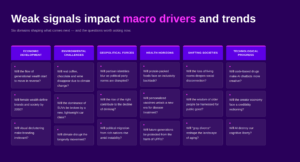
At first glance, some may not seem relevant to your category. That is often the point: weak signals often matter because they sit outside the dominant market narrative. In this blog, we take a closer look at two:
- The rise of AI and its implications for cognitive liberty, and
- The emerging visual decluttering movement and what it could mean for the future of branding.
Weak signal #1: Will AI destroy our cognitive liberty? A deep dive
We first spotted this signal in an essay by Nita Farahany, professor of law and philosophy at Duke University. In the essay, she writes about the growing importance of cultivating “cognitive liberty”, which she defines as “a right to self-determination over our brains and mental experiences”, as well as “a right from unwanted interference with our mental privacy and freedom of thought.” (Source: Nita Farahany, Duke University)
This essay was written in the context of generative AI, with its ability to interfere with mental experiences by distorting facts, reinforcing biases and ultimately influencing beliefs and decisions.
It connects closely to several Foresight Factory consumer trends:
- It is a symptom of Tech Anxiety, which describes the consumer tendency to fear the advances of technology and the negative impact it has on quality of life.
- It also links to Going Incognito, which explores how consumers strive for privacy and invisibility at a time when they feel constantly surveilled by technology.
- But it also pushes against our Choice Partners trend, which looks at the consumer desire for decision-making shortcuts, often facilitated by technology such as agentic AI. If cognitive liberty is ultimately seen as something sacred and worth preserving, consumers may become more hesitant to entrust AI with their personal mental load, burdensome as it may be.
Why does cognitive liberty matter for brands?
This signal will have different impacts for brands across sectors:
Technology impact
This signal has a direct impact on the core function of the sector. In a future where neuroprivacy or cognitive sovereignty becomes a mainstream political issue akin to GDPR, tech companies could be exposed to intense scrutiny – and, potentially, regulation. We are already seeing change in this space, from the rise of digital minimalism movements to social media restrictions driven partly by concern about algorithmic influence on young people’s minds.
- Action for tech sector: Develop a clear internal stance on user agency. Brands need to define where their products assist consumers vs. where they influence them, and how that distinction shows up in product design.
Banking and finance impact
This is already a sector where many consumers lack confidence in their ability to make smart, autonomous decisions. In this context, AI tools could lower cost and access barriers, offering financial education and advice that is free, accessible and personalized.
- Action for banking sector: Here, the opportunity lies in using AI responsibly to promote financial literacy and inclusion.
Media impact
If anti-algorithm sentiment intensifies, consumers may scrutinize not only the trustworthiness of the content they see, but also the cognitive effect it was designed to have on them.
- Action for media sector: Help consumers build information literacy by labeling content clearly, explaining editorial choices upfront and building in features that help people interrogate factual content rather than passively consume it.
Health and wellness impact
This sector is at risk of online misinformation, pseudoscience and conflicting advice. So the issue here is less about safeguarding cognitive liberty and more about providing evidence-backed decision-making guidance.
- Action for health sector: Give consumers verified, structured information and the tools to make smart decisions based on scientific fact.
How does a weak signal become a mainstream trend?

The rise of cognitive liberty as a societal concern is an example of how weak signals can snowball into mainstream, commercially consequential change.
Foresight Factory identified AI and cognitive liberty as a signal in 2023, when the concept was still largely discussed in academia and relatively under the radar in mainstream culture. But its roots go back further. In 2015, we hosted an event where we discussed the need to maximize cognitive capital as AI and automation advanced.
Over time, connected signals began to surface. Will hype destroy the experience economy? Will AI manipulation protect hidden gems? Taken together, these pointed to the same underlying tension: a growing, collective resistance to feeling algorithmically controlled.
We stopped treating them as separate signals and started asking what they were symptoms of. That body of evidence, alongside related commercial examples and consumer data from our proprietary research program, became our Trending 2025 theme, Escape the Algorithm.
Evidence kept showing up across culture, industry, product launches, consumer behavior and social media conversations. And in February 2026, we formalized Escape the Algorithm as a full trend on Collision.
The takeaway is simple: this now rather loud trend began as a whisper. Brands paying attention had several years to get ahead of it.
What’s next for this weak signal: Thought starters for brands in 2026 and beyond
As we continue to monitor new evolutions in this space, there are several questions worth considering when it comes to the impact of AI and cognitive liberty on your brand:
- If mental autonomy becomes an urgent space for consumer protection, can your brand demonstrate that it stands for cognitive empowerment?
- If legislation requires greater transparency around how AI and algorithms are used, what might that reveal about your brand?
- If curation and human expertise become competitive differentiators, will your brand pass the authenticity test?
Weak signal #2: Will visual decluttering make branding irrelevant? A brief overview
This signal is connected to a growing movement on TikTok called ‘visual decluttering’, where consumers remove product labels from beauty products or decant branded items into unmarked containers.
Some consumers see this as an escape from brand fatigue in a world flooded with logos. For others, it is a way to be more intentional about consumption by focusing on the functional use of a product rather than superficial appeal, such as bright or attractive packaging. It has even been described as a way to achieve mental clarity.
While the practice began in beauty and personal care, where consumers transfer shampoos, cleansers and serums into identical neutral bottles, it’s spreading into other categories, from pantry staples to cleaning products.
This is not simply an aesthetic preference. It points to a deeper tension between brand visibility and consumer control. In categories where packaging has historically done much of the emotional work, visual decluttering raises a sharper question: what happens when consumers still want the product, but no longer want the brand noise around it?
A key Foresight Factory trend energized by this signal is Pure and Simple, which explores the desire to remove clutter and cut through complexity with simple, functional solutions.
Brands in retail, food and beverage and beauty should consider the following questions:
- If shoppers increasingly reject branding over functionality, could logos and packaging become less relevant?
- And if visual branding takes a backseat to function, could your brand build emotional connection through product experience instead of aesthetics?
Want to know more? Explore 3 more weak signals from our recent webinar
-
Will climate disrupt the longevity movement?
The longevity market is booming, but the pursuit of longer life faces an underreported hurdle: climate change. If repeated exposure to heatwaves accelerates biological aging, brands across housing, health, travel and beauty may need to help consumers adapt to a world where climate protection becomes part of the longevity agenda.
-
Will partisan identities blur as political party norms are disrupted?
Political polarization is deepening, but traditional distinctions between left and right may be starting to blur. For brands, this reinforces a critical point: consumers are complex, multifaceted and increasingly hard to capture through broadbrush labels. Some brands may need to take a clear stance, while others may find more resonance in shared values or functional value.
-
Will female wealth define brands and society by 2050?
As wealth is transferred across generations and between spouses, women are set to inherit the lion’s share of global assets. This could reshape purchasing power, investment priorities and the meaning of premium across sectors from finance and retail to automotive and food and beverage.
The point is not that every weak signal becomes a mainstream trend. Most will not. The value lies in having a system that can track what is emerging, test whether it is gaining momentum, connect it to wider consumer and market forces, and decide whether it deserves strategic attention. That is where foresight becomes intelligence rather than inspiration.
Watch the full webinar
Weak signals are easy to overlook precisely because they don’t always look commercially relevant at first. But they can reveal where emerging consumer trends are heading before the wider market catches up. In the full webinar, our Foresight Factory experts explore five weak signals and their impact across sectors, geographies and future brand strategy. Watch the full webinar here.