Key insights:
- Parents are bringing the carnivore diet to their kids’ plates. On reddit, the subreddit r/carnivorediet has more than 86,000 members, a number of whom share their experiences of feeding their toddlers mostly animal-based foods.
- Back-to-school 2025 is characterized by financial, emotional and existential pressures. More than 1 in 3 (36%) parents in the UK blame social media for lengthening shopping lists with “must-have” items like bag charms and premium water bottles putting price pressure on parents, Nationwide reports.
- Fresh graduates are resorting to retro measures and costly upskilling in an attempt to get hired. Faced with a hostile job hiring market, Gen Z jobseekers are applying like its 1999 by printing out paper resumés to distribute to would-be employers.
Overview
Why are parents raising “carnivore babies”? How is the world of jobseeking becoming more complex? And what new pressures are facing parents and students this back-to-school season?
Below we explore three topics on our radar this month and their impact on consumers. By scanning the headlines, keeping tabs on social media conversations and tuning into the zeitgeist, we connect the dots between our trends and the wider world so that you can make sense of what’s happening now and what it means for you.
1. Parents are combatting UPFs and sugar with the carnivore diet

With food brands under scrutiny, animal-based diets emerge as a “natural” solution
The carnivore diet, which has been championed by famous figures including US Health Secretary Robert F. Kennedy JR., involves restricting the consumption of plant-based foods, and instead consuming mostly animal products including beef tallow, meat, fish, eggs and some dairy. Now, some parents are introducing the diet to their kids – leading to the term “carnivore babies” – as they aim to reduce exposure to sugar and ultra-processed foods (UPFs).
The supposed health benefits of the carnivore diet are one major reason that parents are drawn to it. This comes at a time when many baby food brands have found themselves in the crosshairs. In the UK in April, a landmark BBC Panorama episode highlighted how six of the country’s leading baby food pouch brands were failing to meet the key nutritional needs of babies and toddlers. This prompted the government to announce that baby food manufacturers had 18 months to cut the levels of salt and sugar in their products and to stop promoting snacks for babies under the age of one. For many supporters of the carnivore diet, animal-based foods like beef tallow and bone broth present healthier, more natural alternatives for babies.
Parents are sharing tips on how to raise carnivore babies – while health experts push back
On TikTok, #carnivorediet has more than 170,000 posts, with many users touting its benefits. And on reddit, the subreddit r/carnivorediet has more than 86,000 members, a number of whom share their experiences of feeding their toddlers mostly animal-based foods.
But health experts warn of the drawbacks of restrictive diets among children, including the carnivore diet. For instance, the US dietary guidelines recommend that toddlers eat a broad diet consisting of vegetables, fruit, dairy, whole grains and proteins in order to get all the fiber, antioxidants and Vitamin C they need for healthy development. NHS recommendations in the UK are similar.
Meat-eating is experiencing a comeback
The rise of carnivore babies also reflects a wider behavioral change: meat-eating, while largely considered to have a negative impact on the environment, is having something of a resurgence.
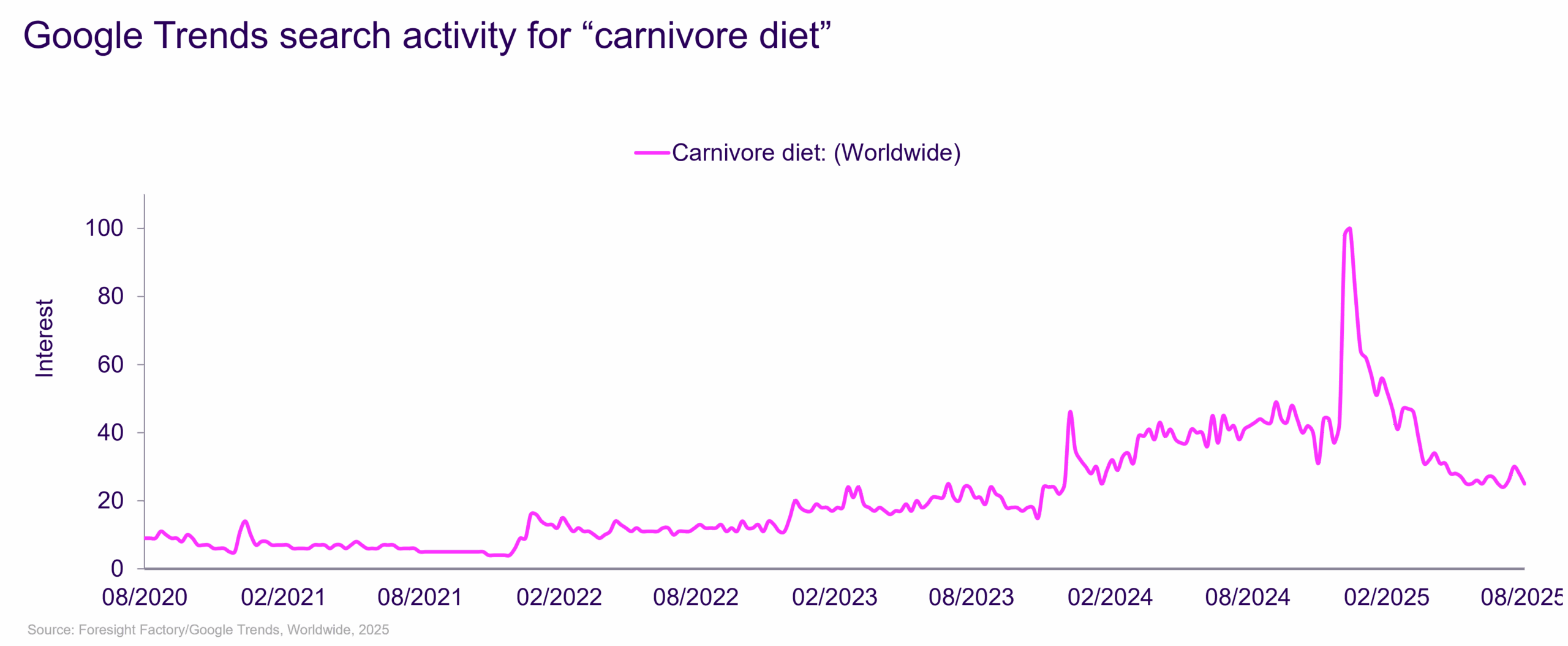
Google Trends data shows that searches for the term “carnivore diet” have climbed in the past five years. Search activity peaked in January 2025, around the time that many people set New Year’s resolutions, often to do with health and diet.
Proponents claim that this low-carb, high-protein diet can help adults lose weight and lower blood sugar. For babies and children, they assert it can improve cognitive function and provide plenty of much-needed protein, zinc and iron. This also comes at a time when protein is at the top of many people’s nutrition goals.
How should brands respond to the growing appeal of the carnivore diet?
- Tap into parents’ desire to make sure their children eat healthily. The focus on carnivore diets partly stems from a frustration with Big Food, alongside concerns around UPFs and their long-term effects on health. But the parameters for healthy behavior are not set in stone: while protein is today’s diet obsession, there are signs that fiber will have its moment next. For brands navigating this ever-evolving space, the important thing is to remain anchored in safety and science. Avoiding loaded terms like “carnivore” and instead providing balanced, expert-led nutritional information can engender trust and loyalty. Above all, parents want to ensure they are raising strong, healthy children.
- Support consumers’ desire to connect to ancestral roots. There’s also a more emotional motivation behind consumers’ interest in carnivore eating: some see it as a return to a primal way of living, connecting us to our ancestral roots. Brands can respond by providing consumers modern-day guidance on how to apply the principles of the past to the present
2. Back-to-school prep is changing in an age of tariffs, Sephora kids and AI

Social media raises kids’ back-to-school shopping expectations
In the UK, building society Nationwide reports that parents are spending more this year, with 9 in 10 saying the cost of back-to-school items is increasing and over half (56%) saying they feel pressure to spend beyond their means.
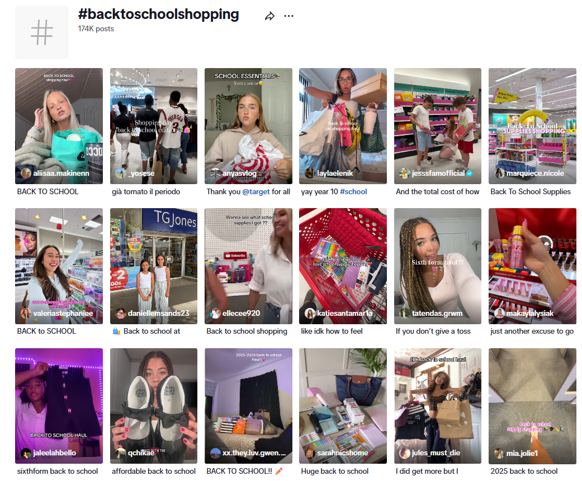 This pressure is likely linked to the influence of social media on kids’ expectations: more than 1 in 3 (36%) parents blame social media for lengthening shopping lists, with “must-have” items like bag charms, designer bags, premium water bottles and beauty buys for teens and tweens – yet another manifestation of the “Sephora kids” phenomenon.
Parents are turning to solutions such as BNPL to manage costs
In the US, research by the National Retail Federation found that two-thirds of parents had already started back-to-school shopping by July, with many citing worries about tariffs and rising costs as reasons for getting ahead. Here too, pressure is building on households to buy across multiple categories, from clothing and school supplies to technology and personal care. Parents are turning to BNPL solutions – as well as considering used or refurbished items – to manage these costs.
In the AI age, new pressures build on students prepping for the world of work
Entry level jobs are disappearing, putting extra pressure on parents hoping to prepare their kids for the working world. At the same time, young adults are questioning the value of further education: Indeed reports that over a third of US graduates say their degree was a “waste of money” and 30% feel that AI has made their qualification irrelevant, rising to 45% among Gen Z.
Google searches for “AI-proof jobs” have been steadily increasing, reflecting growing concern among students and parents alike. This anxiety is likely to bolster interest in alternative pathways such as apprenticeships and encourage students – and their families – to develop an ever sharper focus on colleges and universities that can demonstrably equip students with career-ready skills, access to valuable networks and tangible job opportunities.
For many, this is a moment to reset and refocus on self-care
As parents grapple with many high-stakes decisions, stress is rising. It’s of little surprise, then, that last year the US Surgeon General warned that raising a family could itself be a public health risk, with parents consistently more likely to report experiencing high levels of stress compared to other adults. Many parents are reclaiming their personal health during back-to-school season, potentially sidelined during the summer break. Case in point: a piece in Gulf News encourages parents in the UAE to treat the back-to-school season as a “reset” not just for children but for themselves – from reclaiming quiet mornings to reorganizing home spaces and building moments of calm into the day.
How should brands respond to rising back-to-school pressures?
- Step in as supportive partners with practical tips. The pressures highlighted by back-to-school 2025 are not seasonal – they reflect the deeper, ongoing strains on families. As parents navigate an increasingly difficult landscape – financially, emotionally and existentially – brands can help by alleviating some of these pressures. Nationwide, for example, coupled its research on family spending with practical money-saving and budgeting tips.
- Help parents build financial resilience beyond shopping lists. Parents and young adults will increasingly apply a return-on-investment lens to educational choices: weighing which schools or colleges can deliver clear career pathways, or even questioning the value of higher education altogether. This shift reframes education as a financial or lifestyle decision rather than an assumed life stage.
- Reframe the season as a reset. The back-to-school season should also be seen as a broader moment of reset and renewal, not just for children but for society at large. Parents seek to reclaim me-time as kids return to school, while working adults re-establish routines after fragmented summer breaks. In this context, brands can play a role in helping people re-engage with fitness or wellness goals, rebuild financial resilience ahead of the holiday season, and create a sense of momentum for the months ahead.
3. Gen Z are navigating a hostile job market with paper resumés and portfolio upskilling

Weak hiring and automation are eroding entry-level career paths
Across the world, new graduates are grappling with a difficult job hiring market. In the UK, job search platform Indeed reports that graduate hiring is at its weakest since 2018, federal data shows that job openings in the US are at a decade low, while starting level salaries are at their weakest in four and a half years. Even those students who are graduating with prestigious degrees from elite institutions are faced with a sluggish job market where entry-level roles are sparse.
AI is partly to blame: as the most automatable roles typically sit at the bottom rung, entry-level jobs risk disappearing altogether. The result is a generation struggling to climb onto the corporate ladder.
Gen Z are spending more in an effort to get hired
The paradox of today’s job search is that even as employment opportunities shrink, an entire cottage industry dedicated to helping young people find jobs has sprung up. Career coaches, paid networking groups, LinkedIn Premium, and pro versions of AI tools like ChatGPT and Grok are rising in demand as Gen Z seek to polish resumés, improve interview skills and map out future-proofed career paths. Some candidates are even paying upward of $10,000 for tailored career placements, raising questions around the rising cost of simply trying to get hired.
Many are going old-school and printing out paper resumes to stand out
As jobseekers use AI to polish their resumes, many employers are complaining of a flood of AI-written resumes and how they are creating algorithmic sameness. Recruiters report that applications are increasingly indistinguishable, with many candidates producing near-identical answers. To stand out in a sea of AI-powered sameness, some Gen Z jobseekers are taking a retro approach and applying like its 1999 by printing out paper resumés to distribute to would-be employers.
For some, even the feeling of having a job is aspirational
For example, in China, young unemployed people are reportedly paying $7 a day to pretend to work in office-style “workspaces”. This indicates how as uncertainty around job futures rises, more young people are seeking the structure, community and status associated with employment.
How can brands support Gen Z in their search for jobs?
- Lead with authenticity by being transparent around hiring. Brands can, for instance, provide more information around their hiring policies, and how Gen Z can stand out. As reliance on AI grows – both among jobseekers and recruiters – there is also a role for brands to demystify the dos and don’ts of AI-supported applications. Some employers note that resumés are sharper than ever, but algorithmic sameness in answers is creeping in. Highlight to consumers that your brand values human creativity in an age dominated by AI. Show that while technology can streamline, it’s individuality and authenticity that truly set people apart.
- Position yourself as an ally to young consumers. 42% of 16- to 24-year-olds globally believe “providing good jobs” is one of the top three responsibilities companies have in society (source: Foresight Factory, nine-country average, 2025). Provide access to upskilling opportunities that reflect the skills employers actually demand. For instance, brands can help consumers upskill and enable them to learn essential life skills in an age increasingly characterized by AI.
Talk to us about getting access to Collision
These signals are part of a longer report published on Collision, our dynamic trends intelligence platform. Members get access to these reports at the beginning of every month, so they always have a finger on the pulse of consumers and culture. If you’re interested in learning more about Collision and how the platform can make a difference to your business, get in touch today.