Modern relationships are being redefined by friendship-first bonds, digital fatigue and AI companionship. Foresight Factory’s research shows brands that design for these shifting definitions of connection, not just romance, will build lasting relevance and loyalty. Unlock six opportunities to appeal to consumers through relationships, from friendships to IRL dating.
Relationships no longer follow a set script. Over the last decade, the way people approach romantic relationships has changed due to factors including delayed lifestages, economic hardships, shifting gender norms, changing attitudes to sex, culture wars, the advent of AI relationships, and a growing prioritization of platonic friendships. This is also unfolding against a backdrop of deepening loneliness and a widespread desire to forge meaningful connections in an increasingly digital, social media-first world.
In this report, Foresight Factory explores how consumers are redefining romance, friendship, sex and family relationships, and how people are building support systems that sit outside traditional models. We also outline how brands can respond, whether by helping consumers meet, maintain relationships, or create healthier ways to connect. These shifts are exactly the kind of signal brands need to act on now, not just observe, heading into 2026.
Highlights
- Friendships and chosen family are seen as increasingly important. Friendships now rival romantic partnerships in terms of their importance to identity, and many consumers are exploring friend-first lifestages and milestones such as platonic co-parenting and shared bank accounts.
- Dating app fatigue is driving a desire to return to IRL social formats. In this context, third spaces such as cafes, bookshops, gyms and supermarkets are emerging as facilitators of physical, organic connection.
- Social media adds a public dimension to dating that’s often unwelcome. Young consumers especially fear being embarrassed online. For some, the end result is a withdrawal from the dating scene altogether.
- Intentional singledom and solo-centric living are losing their taboo. Women especially are building unattached lives around autonomy, while even couples are carving space for healthy independence within relationships.
- Sex is increasingly seen as self-care, but intimacy is declining among younger consumers. While part of this is driven by the desire to abstain, for many young consumers, there are other factors at play including economic stress, mental health pressures, a deepening divide between genders and a fear of vulnerability.
- AI is playing the role of both companion and mediator. As AI intimacy becomes more normalized, we’ll see heightened debate around what it does to people’s expectations around human connection, patience and emotions.
1. How is the ‘primary relationship’ expanding beyond romance and family?
Friendship and chosen family are no longer secondary to romance. Romantic partners are traditionally positioned as the central adult relationship. But friendships are now increasingly seen as essential emotional anchors and support systems. Rather than expecting one partner to meet every emotional need, people are seeking intimacy from friends, siblings, online groups, clubs, and religious and faith communities. Rituals like “Friendsmas” capture this shift, and even traditionally romantic rituals are broadening: research from OpenTable shows that Gen Z believe Valentine’s Day is becoming more about celebrating all relationships, not just romantic ones. According to our data, a significant proportion of consumers feel their friendships are important to their sense of identity.
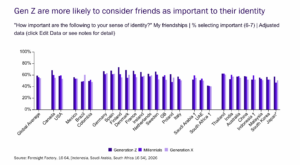
Friends are taking lifestyle leaps together. Buying a house with friends and platonic co-parenting are increasingly popular ways to achieve milestones without resorting to traditional routes. While financial pressure is a core driver, increased trust in friendships as a lifelong anchor is equally important. Consumers are also exploring joint bank accounts with friends in an attempt to achieve “financial intimacy” with someone who is not a partner or family member.
@the_gretaway Replying to @Sammi Jaeger FRIENDSHIP FUNDS ARE A LIFE HACK 🤝🏽💞✨ #friends #travel #adventure #tips #saving #grouptrip ♬ original sound – Greta May
The idea of a fixed family structure is being questioned. Family is increasingly seen as fluid and optional. In households, older adults are co-living with peers to avoid isolation, adult children are living with parents for economic and childcare reasons, and individuals are breaking ties with family members when the relationships don’t serve them. One survey of Americans suggests that nearly 2 in 5 are estranged from at least one family member, and it’s been suggested that Gen Z and Millennials in Western nations are increasingly cutting off their parents for reasons including a more individualist mindset that places less importance on familial obligations. This has implications for our trend Networked Family, where we explore the consumer desire to share advice and support across generations.
What will happen in the next 1-3 years?
Consumers will rely on trusted friendships to achieve their aspirations. With younger people especially facing high living costs and an uncertain job market, more will pursue stability through lifestyles centered around friendships such as co-parenting, co-living or shared home ownership. Dream Downsizing, a key consumer behavior we explore in our Trending 2026 report, will continue to drive decision-making.
How brands can act on this
Design for friendship as a primary unit of belonging. Build services and products that are inclusive of changing relationship dynamics, including the expanded definition of “primary relationships.” This can be applied to bigger life decisions such as home ownership as well as smaller ones such as “friendship” bundles for mobile data or “Friendsmas” hospitality bookings.
Adapt to new lifestages and changing family dynamics. Build services around multi-person households and modern caregiving arrangements, from flexible insurance products and shared benefits to multi-user memberships that recognize co-living, chosen family and platonic co-parenting.
2. Why are consumers choosing in-person connection over dating apps?
Consumers are looking for real-life alternatives to app-based dating. While apps like Hinge and Bumble remain popular, many consumers increasingly want organic connection in real-life settings. Several factors are driving this: choice overload makes dating feel less intentional, and the emotional burnout from excessive, repetitive use of dating apps is leading to swiping fatigue. Moreover, our research shows that online daters report a higher perceived risk of loneliness than non-online daters.

A wider desire to disconnect from screens is reshaping how people want to meet. In our trend Tech Anxiety, we explore how consumers recognize the negative effects of technology in their lives, including the reliance on tech to form and maintain connections. Many view real-life interaction as a healthier way to improve Social Wellness. Our UK and US survey confirms this: more consumers disagree than agree with the statement, “Online dating sites / apps are a better way of meeting people when looking for a relationship than meeting people offline.”
Brands and venues are actively designing for IRL meetings. With many consumers finding it difficult to meet new people, brands are increasingly stepping in to play matchmaker. For example, Arsenal Football Club’s dating show The Big Match is all about bringing fans together over their passion for Arsenal. The show follows fans on a blind date before they head off to an Arsenal game together.

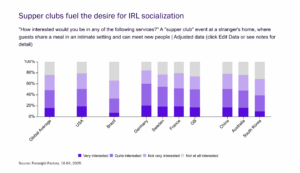
Third spaces are re-emerging as routes to organic connection. Consumers are gravitating toward settings where interaction happens naturally through shared interests, often in a Tactile and Tangible manner: gyms and sports clubs, supper clubs, hobbies, community venues, coworking spaces, cafes, bookstores and even supermarkets. Changing attitudes to alcohol are another driver: as some consumers drink less (or avoid alcohol-led nights out), dating is becoming more daytime, activity-led and community-based.
ASDA’s red baskets initiative is one example of an everyday retail space being repurposed to help consumers meet a potential match. For Valentine’s Day 2026, the supermarket introduced red baskets in select stores in the UK to indicate customers who were open to chatting.
What will happen in the next 1-3 years?
The desire to be more rooted in the present moment will become energized. This aligns with Presence Purity, a consumer behavior we explore in our Trending 2026 report. To counter digital fatigue, more consumers will seek out organic modes of connection based in real-life settings. This will accelerate demand for third-space socializing and dating, as well as reshaping dating apps themselves around features that prompt users to meet more intentionally.
How brands can act on this
Create infrastructure for real-life connection. How can your brand leverage your existing physical space to facilitate social connection? For instance, Tortilla hosted a supper club in one of its London branches to introduce its winter menu. The event included in-person socialization between strangers as well as activities such as chess matches, card games and a pop-up tattoo station.
Design low-stakes, activity-led formats that make dating feel organic. Anchoring events around physical activity, such as cooking, crafts, running, watching a movie or learning a skill, puts the emphasis on shared experience. This will prove especially popular for app-fatigued consumers who want fun and nostalgic formats that feel human. You can lean into Tactile and Tangible cues that keep phones off the table and bodies in the room.
3. How are wellness culture, social media and polarization reshaping dating?
Technology isn’t just changing where people meet; it’s also changing how dating feels. In an always-online world, dating can feel more exposed and higher-stakes, especially when private moments can quickly become public content. Formats such as “GRWM for a date” and post-date debrief videos amplify social risk, with some consumers fearing being filmed, mocked or going viral, and others becoming image conscious. For some men, this contributes to withdrawal from dating altogether.
@alexaabney69 i’m just confused why he sent that to me lol #fyp #baddate #storytime ♬ original sound – alexa abney
Wellness and therapy speak are also reshaping romance, both positively and negatively. Terms like “love bombing,” “co-dependency,” “avoidant,” “anxious attachment” and “boundaries” have migrated from clinical psychology settings into everyday dating talk, especially on social media. On one hand, this gives consumers language to spot patterns and protect themselves in the name of self-care. But it can also flatten the experience of getting to know someone, turning early dating into a process of labeling rather than curiosity. Some see it as weakening social connections, causing people to avoid vulnerability or difficult conversations, and thereby resulting in less intimacy and connection.
Polarization between genders is deepening. Consumers are questioning whether being in a relationship should still hold cultural cachet, with some women “decentering men” and rejecting relationships as a marker of success. Some men, on the other hand, are responding with hesitation or withdrawal, unsure of the new rules of dating and wary of getting it wrong in a post-#MeToo world. All this is unfolding amid a growing loneliness epidemic. Dating app Hinge’s research into Gen Z’s dating patterns confirms this: 84% want deeper emotional intimacy, but they are more hesitant than Millennials to start those conversations, with gendered expectations creating a communication gap.
What will happen in the next 1-3 years?
Cultural backlash against therapy speak in dating will grow. As consumers scrutinize every aspect of their romantic interactions, especially in online spaces, a counter-movement will push back against therapy speak and taking a diagnostic approach to relationships. Instead, consumers will favor interactions that bring out spontaneity, imperfection and curiosity. This will be in pursuit of more low-stakes, fun dating, where the pressure isn’t on “getting the conversation right” but letting connection grow organically.
Meanwhile, polarization between men and women will continue to grow and likely exacerbate the dating and connection gap. Dating itself will start to feel like a cultural battleground for some, especially as political polarization continues to spill into everyday life. Even small differences in outlook, such as supporting a particular influencer or buying from a certain brand, could trigger the severing of ties.
How brands can act on this
Champion connection and community in a growing individualist landscape. Mental health awareness has led to the introduction of vital language and relationship boundaries, but when taken to an extreme, it can normalize cutting people off rather than working through difficulty. Protecting one’s peace can become a shield that avoids compromise and mutual support, making relationships feel disposable and increasing loneliness. How can your brand show that good boundaries and communication deepen connection rather than disrupt it?
4. Why is intentional singledom and solo-centric living on the rise?
For many, being single is a conscious choice. A growing number of consumers, especially women, frame intentional singledom as a positive choice linked to autonomy, self development and freedom from traditional expectations. Rather than seeing being uncoupled as a problem to fix, they build rich lives centered on friendship, hobbies, their career, travel, and more. This connects to our trend Tackling Taboo, where we explore how consumers are normalizing formerly stigmatized topics such as intentional singledom. Morgan Stanley predicts that by 2030, 45% of women aged 25-44 will be single, aligning with broader shifts such as delayed motherhood and the rise of voluntary childlessness.
Self-love is seen as crucial, even within long-term relationships. Many couples are recognizing that maintaining a sense of self, including routines, friendships and personal goals independent of one’s relationship with a partner, can strengthen intimacy rather than undermine it. Some happy couples are even sleeping in different beds, a phenomenon called “sleep divorce,” to get a good night’s rest. This aligns with our trend Solo Living, where we explore how solitude is increasingly being reframed in a positive light. Indeed, many consumers who are married or cohabiting express the need for independence and self-reliance, slightly more so than those who are single (source: Foresight Factory).

What will happen in the next 1-3 years?
Rising singledom will coincide with a countermovement championing the traditional family unit. Declining birth rates will prompt governments to launch initiatives that encourage childbirth. However, for many women, pronatalist messages will clash with the reality of their diminished desire for motherhood. On the other hand, a Trad Revival (an opportunity space we outlined in our Trending 2026 report) will reignite interest in traditional, family-centered lifestyles among some consumers who romanticize early marriage, homemaking and larger families.
How brands can act on this
Meet rising autonomy with flexible events. As more women decenter men and more men hesitate to engage, dating becomes more selective. Your brand can respond by offering experiences that don’t assume coupling as the goal: friend-first events, platonic social gatherings, and experiences that focus on casual connection.
Destigmatize being single. There are societal pressures and stigma attached to solo lifestyles, but the single consumer’s goal is not necessarily to find a partner or raise children. Your messaging can stand out as a celebration of this overlooked group. Highlight the upsides of living life alone, such as more freedom and the ability to be spontaneous and flexible. Messaging that highlights the diverse reasons consumers want to be alone can help to break down taboos.
Encourage consumers to take time for themselves. Brands can play a vital role in informing consumers, especially younger ones, about the joys of self-discovery and personal growth that come with being alone. By championing solo living as an empowering lifestyle choice, one that dispels the pressure of success and companionship faced during early adulthood, brands can help inspire young consumers to embrace their independence with confidence and pride.
5. Why do consumers see sex as self-care, and why is intimacy declining?
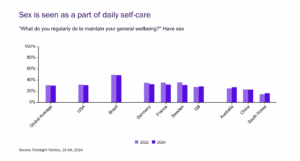
Sex is recognized as a part of overall health and wellbeing. Alongside mental health, fitness and nutrition, sexual wellness is now part of the mainstream self-care conversation. Many feel comfortable talking about their sexual desires, and a meaningful proportion of consumers say they have sex to maintain their general wellbeing.
Attitudes towards intimacy are, for the most part, becoming more inclusive and accepting of sexual fluidity. Consumers, particularly those in Western markets, are more comfortable discussing desire, sexual orientation and relationship styles, with terms like “situationship,” “friends with benefits” and “throuple” entering everyday language. Conversations around polyamory and ethical nonmonogamy (ENM) are also becoming more mainstream. This aligns with our Unapologetically Me trend, where consumers openly express their personal desires.
At the same time, sexual activity among young people is on the decline. Economic stress, mental health pressures, deepening divides between genders, porn saturation and fears of vulnerability all contribute to a growing sex recession, even among those who date or crave connection. While some consumers actively embrace celibacy or asexual and aromantic identities, for others, this lack of sex stems from exhaustion, anxiety or lack of motivation to pursue intimacy. This can contribute to larger societal problems: some commentators have drawn links between lack of sex and reduced happiness.
What will happen in the next 1-3 years?
Political and social differences will continue to affect young people’s sex lives. Deepening polarization between the two genders is likely to drive an even bigger wedge in the sex lives of young people. We may see more women choose to abstain from sex as a form of self-care.
Sex positivity will be questioned in some markets. The revival of traditional ideals and conservative political movements, as well as the war against “woke” culture, will challenge the sexual fluidity narrative.
How brands can act on this
Aim to represent a wider range of relationships. Amid growing flexibility in how consumers approach relationships, from casual “no labels” dating to polyamory, there is a rising expectation that brands should reflect relationships in all their variety. Recruiting those with lived experience can ensure that your messaging doesn’t verge into tokenism.
6. How is AI entering intimate spaces and romantic relationships?
AI for companionship is a growing use case. AI is becoming an active participant in how people experience romance, companionship, emotional support and even sexuality. A report from the Harvard Business Review found that therapy/companionship was the top use case for gen AI in 2025, displacing idea generation, which was the top use case the year prior. A growing number of consumers are forming genuine emotional bonds with AI chatbots and companion apps. Many are building their own AI companions for emotional intimacy, while some are now paying for AI girlfriends.
Consumers turn to AI for help writing openers, processing difficult conversations, understanding their attachment patterns and preparing for dates. According to research from Hinge, 60% of younger Gen Z daters (18-22) say they are open to using AI for dating help as a “virtual second opinion.” While this example is broadly positive, some experts suggest that dependence on AI for dating and mediated conversations may weaken real-world social skills such as patience, listening and compromise over time. Foresight Factory’s UK/US survey shows that comfort with using AI to get relationship advice is growing (source: Foresight Factory, 2025).
As AI companion apps become more sophisticated, ethical questions are emerging. According to some commentators, the use of AI companionship by vulnerable consumers (particularly younger boys) and the integration of AI into sexual wellness may exacerbate the loneliness epidemic. Platforms like Character.AI have already faced scrutiny over companion-like behavior contributing to harm among teen users.
What will happen in the next 1-3 years?
AI will become increasingly embedded in the dating and relationship journey, both as a mediator and a companion. Regulation around AI companionship is likely to be introduced, particularly where minors are involved. As AI intimacy becomes more normalized, we’ll see heightened debate around what it does to people’s expectations of connection, patience and emotions. Dating platforms will offer more AI-assisted features for optimized matchmaking, conversational support, dating profile feedback and more.
How brands can act on this
Explore how and when your brand can safely deploy AI to ease loneliness. Experts suggest that AI should not be prematurely shunned but viewed as a tool that could help alleviate loneliness, if only as a short-term fix or for people with no other friendship option available. In this sense, AI can help improve social wellness. However, the benefits would depend on responsible design and safeguards. As AI moves deeper into intimacy, brands will be expected to foreground safety rather than optimization or engagement.
Encourage consumers to minimize their dependence on AI. Use humor or impactful messaging to highlight how people should practice having difficult conversations without the crutch of an AI chatbot. For instance, your brand could contrast AI-speak and scripted responses with the warmth and awkwardness of genuine human conversations, positioning these as things worth cherishing in an increasingly tech-led world.
Q&A Section: What brands need to know about modern relationships in 2026
- Are friendships replacing romantic relationships as consumers’ primary bond?
Not replacing, but expanding alongside them. Friendships now rival romantic partnerships in importance to identity, with consumers increasingly seeking milestones such as platonic co-parenting, shared bank accounts and co-buying homes with friends rather than partners.
- Why are consumers choosing in-person meetups over dating apps?
Choice overload and swiping fatigue are pushing consumers toward organic, real-life connection. Our research shows online daters report a higher perceived risk of loneliness than non-online daters, fueling demand for third spaces like gyms, cafes and supper clubs.
- How is social media changing the way people date?
Social media adds a public, higher-stakes dimension to dating, with fears of being filmed or mocked driving some consumers to withdraw. At the same time, therapy speak, terms like “love bombing” and “attachment style,” has entered everyday dating language, helping some consumers set boundaries while flattening curiosity for others.
- Why is intentional singledom becoming more common, especially among women?
Many consumers, particularly women, now frame singledom as a positive choice tied to autonomy and self-development rather than a problem to solve. Morgan Stanley predicts 45% of women aged 25-44 will be single by 2030.
- Why is intimacy declining even though consumers see sex as self-care?
Economic stress, mental health pressures, gender divides and porn saturation are contributing to a broader sex recession among younger consumers, even as sexual wellness becomes part of the mainstream self-care conversation.
- Is it normal to use AI for dating and relationship advice?
It’s becoming increasingly common. According to Hinge, 60% of younger Gen Z daters (18-22) are open to using AI as a “virtual second opinion” for dating, though experts caution that over-reliance may weaken real-world skills like patience and compromise.
Understand how consumers are redefining relationships with Collision, Foresight Factory’s dynamic foresight intelligence platform
Modern relationships are a well-defined, commercially significant area of consumer behavior, and knowing the trends exist is only the starting point. The challenge for brands is understanding how consumers’ definitions of friendship, family, dating and intimacy are evolving, what they are responding to, and where the opportunity is moving within your specific category and markets.
Collision, Foresight Factory’s dynamic foresight intelligence platform, is built for exactly this. Through custom audience frameworks and segmentation tools, Collision tracks consumer behavior across 27 markets with 200+ demographic breaks, giving brands a continuously updated view of how relationship dynamics, from friendship-first bonds to AI companionship, are shifting.
With live momentum metrics, maturity and velocity scores, and personalized dashboards configured to your strategic priorities, Collision moves brands from awareness of a trend to confident, evidence-backed decisions about when and where to act.
While other platforms give you data, Collision gives you direction. Speak to us about booking a demo and see how Collision can bring these shifting consumer relationships to life for your brand. Book a demo or get in touch at hello@foresightfactory.co.