Editor’s note: October 2026 consumer trends point to three shifts: fuel price protests worldwide, collectibles as markers of identity and status, and an influencer backlash favoring gated social spaces. Brands must deliver affordability, tactile belonging and authentic connection.
Why are fuel prices sparking protests across the globe? What’s driving the collectibles boom as the holiday gifting season approaches? And why are consumers souring on influencers in favor of more private, gated social spaces?
Below we explore the key consumer trends on our radar this month, and their impact on consumers and brands. By scanning the headlines, keeping tabs on social media conversations and tuning into the zeitgeist, the team at Foresight Factory connects the dots between our trends research and the wider world, so you can make sense of what’s happening now and what it means for you.
Key insights
- Surging fuel prices are fueling protests worldwide, as Middle East disruption pushes oil above $100 a barrel. UK diesel prices have exceeded the previous high set in 2022, while US diesel prices are also reaching record highs. Protests have broken out from France to Indonesia, with consumers in the US and Australia pinning blame on their leaders directly.
- Collectibles are becoming a powerful vehicle for identity and status, particularly ahead of the holiday gifting season. Fans lined up for hours worldwide for Pokémon’s 30th anniversary trading card collection, and 3 in 10 consumers globally highly value collecting as a form of entertainment, rising to 36% among Millennials (source: Foresight Factory, 2026).
- A backlash against influencers is driving consumers and brands toward more private, gated social spaces. A Nantucket antique shop’s “no influencers” sign went viral, while high-profile figures including Nicki Minaj have moved to paywalled, subscription-based content as the appeal of mass reach gives way to curated, authentic connection.
1. A combustible situation: Why are high fuel prices sparking protests worldwide?

Middle East disruption raises oil prices again
While oil prices had subsided somewhat since the US attacks on Iran earlier in the year, recent developments in the region have led the cost of a barrel of Brent Crude to rise above $100. In particular, disruption at Red Sea ports and a drone attack on a key pipeline in Saudi Arabia raised the specter of wider disruption, in what our partners at Oxford Economics have dubbed a “pronounced and persistent” threat to energy supplies.
These developments have very quickly filtered through to prices at the pumps around the world, with diesel in particular being affected. Late September saw records broken in the UK, with the cost of a liter of diesel exceeding the previous high set in 2022. This has been described as “uncharted territory” for the country. The price looks set to rise further, breaching £2 a liter for the first time, which is equivalent to $10 per US gallon. In the US itself, meanwhile, diesel prices were also reaching record highs, of around $6.50 a gallon. Google searches for both gasoline and diesel have been increasing again, having first spiked in February 2026.
High fuel prices lead to protests around the world
In the US, President Trump has attracted much of the blame for higher energy costs, as a result of his intervention in the Middle East in February. Irate consumers have been attaching stickers to fuel pumps and grocery shelves featuring the president’s face and the caption “I did that”. The Australian Prime Minister Anthony Albanese has received similar treatment, as prices reach record levels there too.
View this post on Instagram
Protests have been taking place elsewhere in the world as energy costs reach record levels and shortages lead to panic. There have been demonstrations in France – Europe’s largest user of diesel – while in Indonesia, shortages of cooking gas, rolling blackouts and gasoline rationing have led to protests by taxi drivers. In Guatemala, marchers have called for the abolition of fuel duty. And in Portugal, disgruntled motorists have organized buzinões – protests where cars drive slowly while honking.
View this post on Instagram
What it means
The situation is likely to get worse before it gets better. In the UK, for instance, the question is not whether diesel will exceed £2 a liter, but how high it will eventually reach. Donald Trump’s threat to ban US exports of diesel to protect domestic supplies has been criticized as having the potential to backfire, leading to higher prices at home and abroad and potentially triggering a global recession. As diesel is used by haulers and farmers, higher costs are likely to feed through to the wider economy. Oxford Economics anticipates global CPI inflation of 4.6% in 2026, up from 3.8% in 2025.
A situation of prolonged higher prices and threats to supply could lead to more profound and permanent changes in consumer behavior. Just as the oil price rises of the 1970s led to wider popularity of smaller, more economical cars, current events could push more consumers towards electric vehicles for the first time, for example. It could also boost demand for decentralized energy installations such as plug-in solar panels and battery storage. In this environment, there will be pressure on brands to ensure that alternative solutions are affordable, so that less affluent consumers are not priced out of essential needs such as mobility and home heating.
2. Spotlight on collectibles: Identity-building through objects
Consumers have long been fascinated with collecting sets of covetable products or objects. Today, collectibles are not just a way to signal belonging and identity, but they also increasingly satisfy desires for analog leisure, away from screens. Here we examine the emotional and behavioral motivators behind collectible culture, with insights for brands across categories.

Why is interest in collectibles rising ahead of the holiday season?
As Pokémon celebrates its 30th anniversary this year, its global fandom is still going strong. In September, ahead of the release of Pokémon Trading Card Game’s 30th Celebration expansion pack, consumers around the world lined up for hours for a chance to get their hands on it, from New York to Tokyo.
View this post on Instagram
One Instagram video shows a crowd of people waiting outside a Best Buy store in the middle of the night, two full days before the release. And Australian press has reported on the phenomenon of scalpers selling the cards at a 230% mark-up on eBay and Facebook Marketplace.
The hype around Pokémon’s anniversary collection is just the latest example of just how much of an emotional hold collectibles can have on consumers, particularly where nostalgia and identity are involved.
More broadly, Google searches for “collectibles” saw a notable spike earlier this year, coinciding with yet another Pokémon release.
And it’s not just games and toys that are in demand in this space; looking at Google search activity connected to “limited edition” as a topic, other associated breakout topics include “Nike Store”, “Dior”, “eye palettes”, “New Balance” and “Crocs”.
Who collects? Collectibles as a status symbol, particularly among the wealthy
Even as aesthetic minimalism continues to be touted as an aspiration, consumers continue to acquire stuff. Collecting is not a niche behavior; globally, 3 in 10 say that collecting items for a hobby or personal collection is a very valuable form of entertainment, rating it 8-10 on a 10-point scale (source: Foresight Factory, 2026).
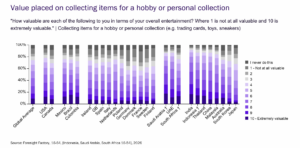
At a generational level, Millennials are most likely to highly value collecting, at 36%, and the attitude is most widespread in India, Saudi Arabia, the UAE and Indonesia. Those who describe their financial situation as comfortable are significantly more likely to value collecting – probably because they have the monetary means to do so. Despite the rise of the “experience economy”, the acquisition of physical objects continues to be a status flex.
One of the attractions of collectibles is that they are often limited-edition: 39% of global consumers agree with the statement “I am more likely to buy an item if I know it is limited edition and will run out”, rising to 1 in 2 (49%) high-net-worth individuals, (source: Foresight Factory, 2025). Those in the UAE, Saudi Arabia and Japan are particularly likely to agree, at 51%, 50% and 49% respectively. However, 30% of global consumers disagree, indicating that artificial scarcity can repel almost as much as it attracts. Among HNWIs, only 25% disagree.
How do physical collectibles provide relief from digital fatigue?
 While streaming and digital experiences mean that music, film and other forms of entertainment are readily accessible at the click of the button, consumers still find appeal in physical media. Indeed, CDs have enjoyed a spike in sales, with revenue up by nearly 60% in the first half of 2026. While vinyl records remain more popular than CDs in terms of units sold, CDs have outpaced vinyl in terms of growth.
Record labels continue to put out CDs, attracting fans who want a physical piece of their favorite artists’ work. For example, in November 2026, Bob Dylan is releasing The Rolling Thunder Revue, a 39-CD collection featuring recordings from his 1976 tour, featuring hundreds of never-before-heard tracks.
One reason behind the rise of physical could be that the physical act of putting on a record or CD, holds particular appeal in a world where more and more areas of life are migrating onto screens. 65% globally agree with the statement “I find activities that involve using my hands to be soothing”, with no real skew across gender, age group or income level (source: Foresight Factory, 2025). We’ve seen upticks in agreement between 2022 and 2025 in markets including Canada, Denmark, Sweden, GB and Thailand.
And 62% globally say that they actively seek leisure experiences that allow them to be fully present, free from screens and notifications (source: Foresight Factory, 2026). Collecting objects – whether that’s CDs, stamps, perfumes or sneakers – gives consumers a way to be physically present and embracing full sensory engagement away from technology.
What is “kidulting”? Demand for games, toys and blind boxes builds across age groups
 From Jellycats to board games, squishies, fidget toys and Labubus, toys are no longer reserved for the young. More adults are “kidulting” – embracing toys and play – as a means of escaping the pressure of modern life. According to data firm Circana, toy sales grew by 7% worldwide in 2025, with that growth attributed to adult users. This has expanded the window of purchase, with adults buying toys for themselves at all times of the year, as opposed to the holiday season spending spike that’s typically associated with buying toys for children.
Brands are responding to the kidulting phenomenon with exclusive releases and collaborations designed to hook adults. For example, live shopping app Palmstreet has teamed up with designers Plastic Pizza and Revise D to launch Tail & Feathers Blind Box Series 1, limited edition collectible art toys that are hand-painted and signed by the creating artists. Blind boxes cost $50 each. By making each purchase a surprise, the launch connects into consumers’ desire for everyday serendipity and unpredictable fun. In the same way that children enjoy watching unboxing videos and opening a surprise toy in their Happy Meals, adults also find pleasure in the unexpected.
Why it matters
– Collecting is relevant across sectors and categories, from fashion and beauty to food and drink, sports, automotive and media. For brands, the opportunity lies in creating product offerings for consumers that provide a way to signal belonging, status and identity within their areas of passion and fandom. For example, Kellogg’s is reintroducing collectibles inside select cereal boxes, playing on the nostalgic allure of a childhood fixture.
– While limited edition products hold appeal for some, it’s important to note that exclusivity is not universally appealing. The strongest collectible propositions will combine a satisfying physical experience with opportunities for discovery, play, surprise and nostalgia.
3. Influencers come under fire as gated social media grows in popularity

Why are consumers turning against influencers? Privacy concerns whip up anti-influencer sentiment
While online influencers have long divided opinion, there has been a recent groundswell of backlash against them. In one celebrated case, a small antique shop on Nantucket island in Massachusetts went viral after it displayed a handwritten sign saying “no influencers”. This came after the establishment was regularly deluged with content creators, some of whom were sent to the area by companies to create promotional videos. The shop’s proprietor explained: “A lot of people are tired of feeling like extras in someone else’s video.”
View this post on Instagram
Privacy concerns due to the ubiquity of filming content for social media are a wider phenomenon. Sociotechnologist Dr. Sarah Saska has commented: “The sight of an influencer filming in public no longer reads as one person making content. Increasingly, it reads as the visible frontend of a much larger surveillance system.” It comes after US gym chain Tracy Anderson banned nonmembers from using phones on its premises to avoid recording. The growth of smart glasses has also fueled concerns about privacy and surveillance recently.
Influencers have come under fire for other reasons too. The 2026 US Open tennis tournament was said to have been diminished by an influx of influencers in the audience – so much so that a match involving Naomi Osaka was briefly interrupted as a ring light was being used in a hospitality suite. Meanwhile, there was widespread criticism when OpenAI sent a team of influencers to upstate New York to engage in a range of activities including painting and beekeeping. This could be because the content seemed far removed from OpenAI’s activities, as well as consumer dislike of the company in general.
View this post on Instagram
Why are celebrities and everyday users limiting access to their social media?
At the same time, a number of well-known individuals have begun restricting their social media feeds. Rapper Nicki Minaj attracted attention in August when she announced that fans could now pay to access exclusive content on her X account. While some criticized the move, others claimed they were excited to access the material at a cost of $10.
I finally did it.
You can now subscribe to my X account.
It’s for ppl who wanna have fun, think deeper, grow, learn, laugh, cry, cuss ppl out, look cute sometimes, be yourself at all times…
elevate, levitate, meditate.Exclusive Spaces & Content 🎀
Welcome Aboard 🔑 pic.twitter.com/e3W7j4Eqc9
— Nicki Minaj (@NICKIMINAJ) August 1, 2026
Around the same time, Trump Media and Technology Group launched a subscription-based data service allowing users early access to posts on Truth Social, including those from President Trump. Aimed at businesses looking to get commercially relevant information as quickly as possible, the service could cost up to $100,000 a month. The move was criticized by some as market manipulation and insider trading, with two media groups filing a lawsuit against the President over it.
It’s not just high-profile figures who are restricting access to social media. So-called “ghost-posting”, where users immediately archive their posts, then release them at a later date to make them less prominent in other people’s feeds, is growing in popularity on Instagram, especially among Gen Z. In the words of one ghost-poster: “Ghost-posting became a way for me to have things that were happening in my life out there, but not necessarily broadcast them.”
A desire to curate an authentic reflection of self also drives enthusiasm for the reported return of early-2000s social media brand MySpace. While no date for the relaunch has been announced, many fans hope it will herald a return to the origins of social media, which existed to bring together close friends and acquaintances.
Why it matters: What the influencer backlash means for brands and gated communities
One thread running through these developments is a shift in the idea that the overwhelming aim of social media is to achieve as wide a reach as possible. It seems success is no longer viewed solely by the number of impressions, likes and shares. Instead, the value of meaningful connection and information dissemination is being reinstated. This reflects a desire among consumers to share their authentic selves, as well as focus on positive connections with people they value. There is also cachet to be derived from feeling part of an exclusive group rather than one of the masses.
These shifts in social media mirror a wider development whereby the internet itself may no longer be engineered to appeal to as many humans as possible but instead optimized for LLMs and bots powered by Artificial Intelligence. In other words, the attention economy may give way to the agent economy, with clickbait no longer the holy grail. These developments could be an opportunity for companies with strong brand equity, who can build more direct, gated communities and channels to connect meaningfully with customers.
Frequently asked questions: October 2026 consumer trends
Q: Why are fuel prices causing protests around the world in 2026?
A: Middle East disruption, including problems at Red Sea ports and a drone attack on a key Saudi pipeline, has pushed Brent Crude above $100 a barrel. UK diesel has broken its 2022 record and US diesel is near $6.50 a gallon. Protests have followed in France, Indonesia, Guatemala and Portugal, while consumers in the US and Australia are blaming their leaders directly.
Q: How could high fuel prices change consumer behavior long term?
A: Just as the 1970s oil shocks popularized smaller, more economical cars, prolonged high prices could push more consumers toward electric vehicles and boost demand for plug-in solar panels and battery storage. Brands will face pressure to keep these alternatives affordable so less affluent consumers are not priced out of mobility and home heating.
Q: Who buys collectibles, and why are they so popular?
A: Foresight Factory data shows 3 in 10 consumers globally highly value collecting as entertainment, rising to 36% among Millennials, with financially comfortable consumers especially engaged (source: Foresight Factory, 2026). Collectibles signal identity and status, tap into nostalgia and offer screen-free, tactile leisure at a time of digital fatigue.
Q: Do limited-edition products help brands sell collectibles?
A: It depends on the audience. 39% of consumers globally are more likely to buy limited-edition items, rising to 49% of high-net-worth individuals, but 30% actively disagree (source: Foresight Factory, 2025). The strongest propositions pair a satisfying physical experience with discovery, play, surprise and nostalgia rather than relying on scarcity alone.
Q: Why are consumers turning against influencers?
A: Privacy is a key driver: constant filming in public increasingly feels like surveillance, as shown by a Nantucket shop’s viral “no influencers” sign. Disruption at events such as the US Open and brand campaigns that feel disconnected from the company have added to the backlash.
Q: What does the shift to gated social media mean for brands?
A: Success on social media is no longer measured solely by reach. From Nicki Minaj’s paywalled content to Gen Z ghost-posting, consumers are prioritizing authentic connection and exclusivity. Brands with strong equity can respond by building more direct, gated communities and channels to connect meaningfully with customers.
Talk to us about getting access to Collision, our dynamic intelligence platform
These October 2026 trends are part of a longer report published on Collision, Foresight Factory’s dynamic trends intelligence platform. Members get access to these reports at the beginning of every month, so they always have a finger on the pulse of consumers and culture. If you’re interested in learning more about Collision and how the platform can make a difference to your business, get in touch today.