Introduction
What is the significance of young people around the world taking to the streets? Is there more to the philanthropic gestures of Big Tech leaders than meets the eye? Why are more brands becoming patrons of the arts? And what are the drivers behind a “proximity shift” among consumers?
Below we explore the key consumer and culture trends on our radar this month, and their impact on consumers and brands. By scanning the headlines, keeping tabs on social media conversations and tuning into the zeitgeist, the team at Foresight Factory connects the dots between our trends and the wider world, so you can make sense of what’s happening now and what it means for you.
New for this month: We are also resurfacing signals and stories previously explored that are energized and relevant once again. Click here to explore how we identified the emergence of these topics.
1. A generation in protest: Why are disillusioned Gen Z youth taking to the streets?

What is driving Gen Z toward protest in 2026?
Youth protest and civil unrest have long been catalysts for political change. 2026 is no different, with riots and demonstrations breaking out around the world as Gen Z contend with compounding pressures around AI, climate change, political corruption, geopolitical conflict, education, cost of living and more.
Hundreds of thousands march in Paris over the cost of living, fuel prices and the student movement.
Troops guarded strategic sites, but clashes still broke out. More than 1,000 people were arrested. https://t.co/0sIUntHxzt
— euronews (@euronews) October 24, 2026
In France, nationwide protests turned violent in October, with rioters storming and looting shops while police fired tear gas and water cannon to disperse the crowds. What began as a peaceful student-led demonstration against poor school conditions evolved into nearly a month of protests across the country, with hundreds of thousands taking to the streets over growing inequality and the worsening cost-of-living crisis. President Emmanual Macron is now under pressure to increase public spending to satisfy protesters at a time when France is already facing a substantial debt crisis. And some commentators believe the protests will strengthen Marine Le Pen’s credibility as a presidential candidate next year, with the far-right leader keen to bring law and order to the country. She formally launched her presidential bid on Sunday October 25th.
That same weekend, thousands also took to the streets to protest in Italy, Albania, Spain and Portugal, coalescing around a desire to tackle rising living costs, poor education standards and the consequences of war. The Times of India referred to it as “Europe Spring”, harking back to the Arab Spring movement of 2010-11, which spread across dozens of countries in the Middle East and Africa, removing several long-standing autocrats from power.
How is a widening generational divide fueling youth anger?
It’s notable that younger generations are largely driving these protests globally. Digital native Gen Z entered their formative years during the pandemic, which curtailed their access to education and workforce opportunities. Now, AI is limiting their opportunities even more, while geopolitical unrest, housing shortages and economic uncertainty are just a few features of the persistent cost-of-living crisis that has arguably hit Gen Z the hardest. As a result, they are angry.
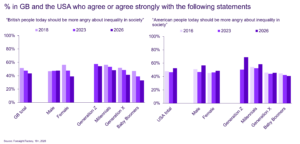
Our data shows that the proportion of people who agree with the statement “British people today should be more angry about inequality in society” has declined at a topline level and across most generations, with 44% of Britons now agreeing, down from 52% in 2018 (source: Foresight Factory, 2026). Among 16- to 24-year-olds, however, we don’t see that same drop, with 55% agreeing in both 2018 and 2026 – suggesting a consistent sense of dissatisfaction is driving a wedge between this cohort and their older peers.
The difference is even starker in the USA: 69% of 16-24s agree with the statement “American people today should be more angry about inequality in society”, up 20 percentage points in just three years. Gen Z are notably more likely to agree than other generations.
How are connected youth movements and fandoms driving political change?
It can be easy for young people to feel powerless, but recent events show that grassroots movements can effect real change – in new and surprising ways.
Back in 2025, we wrote about how Gen Z in Nepal led an uprising against corruption that resulted in a dismantled government and a new interim prime minister voted in via the social media and instant messaging platform Discord. It was a powerful demonstration of how youth culture and digital media are reshaping political participation, turning online communities into real-world movements capable of challenging established power structures.
And in October, another unlikely group of people mobilizing online and IRL helped Brazilian president Lula da Silva secure a fourth term: pop music fandoms.
View this post on Instagram
The Guardian reported that more than 600 fanbase groups dedicated to artists like Taylor Swift, Billie Eilish and Harry Styles came together to campaign for Lula’s re-election, taking advantage of the Peer Power that such groups carry. “A lot of people don’t keep up with politics, but they do follow fanclubs and fan accounts, so I think fandoms can bring this kind of discussion to more people,” said one Beyoncé fan. And a fan of K-pop group BTS said: “We need to step up and make ourselves heard.”
Meanwhile, in Serbia, long-standing autocratic leader Aleksander Vučić was forced to accept defeat in the Presidential election in October after a youth movement called Student List successfully led a national movement against corruption and government negligence. “This is not an ordinary election victory,” Nebojša Vladisavljević, Professor of Political Science at the University of Belgrade told the BBC. “This is an avalanche that has wiped out an authoritarian regime and entire political scene.”
Why it matters
- For Gen Z trying to establish themselves in a world in permacrisis, protest is becoming an everyday tool for exerting influence. The success of recent youth movements has shown them that power can be built through grassroots efforts, which can quickly turn a shared frustration into coordinated action. With much of the world heading to the polls across 2027, we could see more of this behavior as young people look to make their voices heard.
- The rise of fandoms as a vehicle for political action has interesting implications for brands too. Many are heavily investing in building fandoms and communities to create loyalty and cultural relevance, but these groups can increasingly take on a life of their own, outside a brand’s control. Brands should therefore treat communities as legitimate stakeholders to consult, not just audiences to attract. Whether it’s a subreddit, a fan account network or a creator ecosystem, give communities legitimate routes to influence across your brand, providing ways for members to actively participate and be heard.
2. The era of Big Tech philanthropy? Why are billionaire tech donations sparking debate?

Why are tech giants using philanthropy to win hearts and minds?
Two related announcements from tech companies have attracted much debate. AI giant Anthropic, led by Dario Amodei, announced it would direct 5% of its stock to a subsidiary that will aim to benefit the wider public, for instance by researching how AI will change the labor market. Soon after, Elon Musk declared that he would gift one SpaceX share to every child in the US, at a total cost of $10.5 billion.
We’re committing a portion of Anthropic’s shares to the Anthropic Public Benefit Fund, a new wholly owned entity dedicated entirely to the public benefit.
It will start off with 5% of our shares. For every 50% increase in the company’s value over a set baseline, we can contribute up to an extra 2%, subject to our board’s discretion.
In total, this means that roughly 20% of Anthropic’s shares are committed to the public good. Our co-founders have already pledged to donate 80% of their equity, and around half our employees are donating a portion of their equity as part of a donation matching program we’ve run since our founding.
In the post below, we share more details about our new fund.
https://t.co/XzDntVH0vH
— Anthropic (@AnthropicAI) October 18, 2026
However, both announcements were greeted with skepticism and outright hostility by many. Replies to Anthropic’s tweet making the announcement include one from a user who said: “Well, I’ve lost 80% of my income over the past 3 years thanks to AI like yours. Where can I apply to your ‘public benefit fund’ to get that money returned to me?”
Anthropic’s move can be seen as a way to curry favor with consumers amid wariness about the impact of AI in areas such as employment and the building of large data centers. It has also recently come to light that the AI industry is targeting its public relations efforts at children, with a children’s coloring book called What Is A Data Center? making headlines, and companies sponsoring school visits to data centers to demystify the industry.
Even before the latest announcements, questions were raised about the motives of AI philanthropists, and there has been much discussion on the topic of giveaways by the mega-rich. In particular, some are concerned about the power and influence wielded by a very small number of individuals who are not accountable to voters – in other words, a plutocracy. While previous eras saw rich philanthropists such as Andrew Carnegie and J.D. Rockefeller fund public buildings and scientific research, critics question whether philanthropy is the most appropriate way to redistribute wealth in today’s world.
How is Big Tech’s political influence being scrutinized ahead of the US midterms?
The presence of big tech leaders such as Meta’s Mark Zuckerburg and OpenAI’s Sam Altman at US political events has been notable in recent years. None has been quite so prominent, however, as Elon Musk, who was even in charge of the Trump Administration’s short-lived Department of Government Efficiency (DOGE).
Musk’s political maneuvers have continued in the run up to November’s widely anticipated midterm elections in the US. He has been particularly vocal on the subject of James Talarico, the Democratic Texas state representative who is campaigning in the Senate elections. Besides making a $158 million donation that supported Talarico’s Republican opponent Ken Paxton in the hotly contested race, Musk has described Talarico as a “creep” and “deeply wrong”. In response, Talarico has said: “There is something deeply wrong with a political system that allows one trillionaire to buy his own personal U.S. Senator.”
There is something deeply wrong with a political system that allows one trillionaire to buy his own personal U.S. Senator.
— James Talarico (@jamestalarico) October 22, 2026
Musk has not limited his interventions to US politics, and there are many examples of him commenting on developments in the UK, Germany, Spain and elsewhere. He also reportedly ordered the slowdown of the military version of the Starlink satellite service in a way that would hinder Ukraine, which relies on the service in its ongoing conflict with Russia. This example in particular demonstrates the power and influence that can be wielded by one unelected individual.
Consumers are relatively unanimous on the topic. When asked whether they think “billionaires are better qualified to run the country than politicians”, 23% of Americans and 20% of Brits agree, while 53% and 58% respectively disagree. It’s notable, however, that agreement rises to 38% among US Gen Z and 33% among British Millennials, perhaps suggesting that disillusionment among younger generations with professional politicians may lead some to view successful entrepreneurs as attractive alternatives (source: Foresight Factory, 2025).
Why it matters
- The debate generated by these philanthropic announcements highlights widespread concern about the impact that Artificial Intelligence in particular is already having on many aspects of society, the ambivalent attitudes of many consumers around the world, and the need for AI companies to gain a more favorable reputation among some sections of the public. As the reach and impact of AI grows, companies in many other sectors that rely on the technology will face questions about the impact of their operations on jobs, the environment and even human safety, and will need to offer convincing explanations of their attitude to AI.
- As we cover elsewhere in this issue of What’s Trending, constrained public finances are leading to unrest among young consumers in particular. In this context, the importance of philanthropy is emphasized: could donations by rich individuals plug gaps in funding that the state can no longer fill? However, the influence of the rich highlights issues around Financial Inequality and Societal Polarization. When rich and powerful individuals such as Elon Musk share their divisive views publicly, controversy is sure to follow. One wider implication for companies in all sectors is the need to consider whether their CSR activities will face increased scrutiny from activist consumers. Motives may be questioned, and contributions to causes that are seen as divisive will lead to criticism from some quarters. Brands should review their policies in this light, always remembering that staying true to core values is likely to be viewed most favorably.
3. The commercial value of the arts: Why are brands and athletes embracing the arts?

What role does human-made art play in the age of AI?
At a time when AI can make a song, painting or short film in seconds, the arts are facing an existential reckoning. But far from driving down interest in human-made art, the rise of AI seems to be increasing its value – and inspiring new initiatives and partnerships aimed at knowledge-seeking consumers.
One key shift in this discourse is how brands engage with the arts. Brands have always worked with culture, connecting with people through collaborations, content, installations and more. But now, a growing number of brands are moving away from putting themselves at the center of the arts and towards becoming facilitators. As Vogue puts it, rather than trying to create culture themselves, these brands are funding the conditions that let others do so.
How are fashion and beauty brands earning cultural clout through arts patronage?
This shift is showing up across sectors, though it’s particularly strong in fashion. In September 2026, French fashion house Dior signed a two-year creative partnership with entertainment company A24, becoming the main partner of Cherry Lane Theatre, the New York Off-Broadway venue that reopened in 2025. It launched with a one-night performance rather than a campaign, and the deal includes support for emerging artists and students.
Loewe has long played patron of the arts: its Foundation Craft Prize, now open for its tenth edition, funds and promotes craftspeople working outside fashion, while the brand’s new residency with Belmond hotels hosts former finalists of the Foundation Craft Prize in Mallorca.
It’s not just luxury fashion houses that are leaning into this. In San Francisco, Gap is opening its headquarters to local creatives through “The House”, a program of “quarterly performances by Bay Area musicians, rotating residencies and site-specific installations”. It will also commission new work, host workshops with textile artists and makers, support local craft-based businesses, and partner with the Institute of Contemporary Art San Francisco. And AllSaints has announced a partnership with independent print magazine The Toe Rag, making issues available at all AllSaints global flagship stores.
Meanwhile, in the beauty sector, Saie Beauty has launched the Saie Culture & Arts Program: small, in-person events built around bringing its community together through art, music, architecture and ideas. Events range from a sketching session in Philadelphia’s Calder Gardens to a private tour of the Art Gallery of Ontario in Toronto.
What is driving the rise of the “Renaissance Athlete”?
Another notable thread here is the extent to which art and sports are intersecting, with athletes increasingly framing their sport as a creative and intellectual practice. It’s a shift that has been dubbed the rise of the “Renaissance Athlete”. For instance, during the 2026 NBA Finals, San Antonio Spurs star Victor Wembanyama went viral when he sketched a statue in a New York City park hours before the game in order to “clear his head”. NFL wide receiver Stefon Diggs launched Si Vis Pacem, a collectible furniture line that debuted at Design Miami in 2025 before getting its own exhibition at New York’s Tuleste Factory. And Steph Curry’s new documentary, Portrait of an Artist, frames his record-breaking three-point shooting as an art form, alongside voices from creatives such as Patti Smith, Rick Rubin and Viola Davis.
At the Winter Olympics in Milan and Cortina, figure skater Alysa Liu won gold after a two-year break from the sport, returning with dyed hair, pop music and a focus on expression over perfection – she has described skating as her art rather than an obligation. Freestyle skier Eileen Gu has long said that skiing and fashion share the same roots in self-expression and creativity, and doesn’t believe in separating her athletic identity from her intellectual and creative ones: “Athletes have always been creators, I think the world is just waking up to it”, she told TIME.
Sportswear brands are leaning in by exploring partnerships and experiences grounded in the arts. Lululemon launched a running and lifestyle capsule collection with artist and ultrarunner Geoff McFetridge, and adidas and Salomon backing a listening party and a creatives retreat.
Foresight Factory consumer data reveals a similar and unexpected link between athleticism and intellectualism. In the US, when looking at the value that consumers place on various forms of leisure entertainment, we see a stronger correlation between taking on sporting challenges and keeping up with the news among Gen Z than among the total population. Perhaps this indicates that athleticism and knowledge-seeking are merging into one marker of status – at least among younger consumers.
Why it matters
- The rise of brands as patrons of the arts may in part be in reaction to AI, and the growing sense of unease about its impact on creativity. As AI-generated content becomes cheaper to create and more widespread, proof of human skill, effort and taste is gaining worth. Patronage also gives brands a way to engage with culture while avoiding accusations that they are borrowing credibility from art without giving anything back. It also allows brands to take a step back, giving consumers space to engage with the arts on their own terms. This creates an opening for brands in all sectors to support the spaces, institutions and people that make culture happen.
- Learning and creativity are becoming markers of status, as we explored in a previous What’s Trending report, Philosophy’s comeback: Is critical thinking the new cool? But patronage brings its own scrutiny. Consumers will question whether support is lasting or a short-term PR exercise, and whether artists are given real freedom. Brands that enable artists to create on their own terms will gain cultural credibility and be seen as true patrons of the arts.
4. The proximity shift: Why are consumers going local and seeking intimacy?

Why have the habits of community eroded?
Thanks to a range of factors, from the pandemic to greater tech use, there has been much talk of a loneliness epidemic and a desire for more social connection in recent years. There has also been a striking decline in face-to-face socializing. In the US, for instance, the proportion of Americans hosting friends or family at home at least once a month has fallen from 42% to 12% since 1975 – a 70% decline in 50 years.
Only 16% of global consumers say they socialize with others as much as they would like to, while 84% identify at least one barrier to socializing with others more, with cost being the most widespread (source: Foresight Factory, nine-country average, 2025). We cover this topic in more detail in our report on The socializing gap.
Physical third spaces are also in decline as a result of factors including privatization of public spaces and high rent costs, along with the decline of religious and civic participation, remote working and at-home on-demand entertainment. Meanwhile, significant minorities say they feel lonely: 37% globally, rising to 41% of Gen Z, 42% of Americans and 1 in 2 South Korean consumers.
Against this backdrop, consumers are seeking connection that is easier to maintain. This is the proximity shift: placing greater value on familiar places, repeated interactions and smaller, trusted circles, both offline and online.
Why is consumer trust moving closer to home?
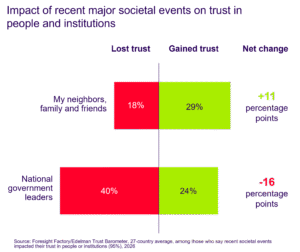
Trust is an important aspect of this shift: recent societal events have strengthened trust in close personal networks while weakening trust in national government leaders. 29% of global consumers say they have gained trust in their neighbours, friends and family as a result of a major societal event in the past five years, compared with 18% who say they have lost trust (source: Edelman Trust Barometer, 27-country average, 2026). This represents a net trust gain of 11 percentage points, compared with a net trust loss of 16 percentage points for national government leaders.
Peer-based advice has long been influential in decision-making, but it has renewed relevance today. The spread of AI-fueled misinformation is a strong driver of trust becoming more proximity-based, as consumers find it increasingly difficult to trust what they see and read. Instead, a genuine interaction or conversation with a known person or community establishes credibility. What’s real, nearby and known is now the most trusted thing consumers have.
As part of its ten-year forecast for 2036, the Institute for the Future speculates on a future that boosts human ways of knowing, including the related idea of “neighborist discernment” – the practice of establishing trust through “reputation, proximity, and repeated interaction”.
What is localmaxxing? Why consumers are choosing familiarity over novelty
Importance of the local area to personal identity | “How important are the following to your sense of identity?” The area I live in | % selecting important (6-7)

The importance of the local area to people’s identity has been rising among consumers. In 2026, 1 in 2 (49%) global consumers rated the area they live in as important to their identity, up from 43% in 2021 (source: Foresight Factory, 22-country average).
As an expression of this, consumers are actively leaning into activities and spaces that strengthen local connections. For example, the term regularmaxxing took off earlier in 2026 as a way for Gen Z to describe becoming a regular customer at a local venue such as a coffee shop or bar – something perhaps taken for granted by previous generations. Instead of chasing somewhere new, the appeal comes from returning often enough to develop familiarity and community.
regularmaxxing changed my life.
i go to the same café every day to work. and tip between 30-50%.
now i walk in like i own the place:
– they gave me a paid-for parking spot
– when i bring friends, they get orders for free
– can make myself off menu drinks
– can send my parcels there
– they are community, introduce me to other regulars
– got employee wifi, kept my mac charger therei did that in nyc, cpt, bcn. it works everywhere if you stop chasing the dopamine of “new”
— dennis (@dennismuellr) January 6, 2026
Brands are highlighting the important role of local infrastructure in consumers’ lives too. For example, Coca Cola launched a campaign in October 2026 called Local Royalty, paying homage to four independent businesses across the UK by commissioning portraits of their owners by artists who typically paint royal portraits, to be shown at the Saatchi Gallery. The owners received a donation to a local charity of choice, as well as the portrait. Rhona Stephen, Senior Director, Communications at Coca-Cola GB&I, described the businesses as “the epitome of community spirit”. The brand’s research found that 79% of British people believe independent businesses are underappreciated.
Rebuilding intimacy: How are consumers building closeness through low-key rituals?
It’s not just about repeat visits to local venues. This shift is also expressed through building regular, low-key routines and rituals that not only boost community ties but can also solidify close friendships. This can include standing plans, where people meet at the same place and time on a regular schedule. Other examples include admin nights or parties where consumers get together to complete dull tasks side by side, at-home “office hours” that encourage friends to drop in to work remotely together, and home cafés that turn kitchens into weekend coffee shops. The aim is to take the pressure off connecting with others, making it lower effort and less performative – but more intimate in turn.
This also connects to conversation around the concept of building a “village” – a support network or community that people can rely on and give back to, particularly but not exclusively in the context of parenting. There is a proven positive impact on wellbeing of having strong relationships and social ties. However, expectations of mutual support can differ.
A recent TikTok video illustrated this tension through a debate about whether asking to stay with friends is an imposition or an ordinary part of friendship. In the video, creator @bridgetgoes discusses how she believes it is “rude” to ask to stay with friends in a city like New York after attending a concert. The video received around 153,000 likes and 24,000 comments. Most of the comments were negative, pushing back against the creator’s point of view, with one comment reading: “This is so individualistic. All my friends know they have a place to stay anytime for any reason and I don’t need anything back.” The comment received over 40,000 likes. A viral response video also shared a contrary view, with creator @zoertoast saying she would be “sad” if her friends didn’t ask to stay with her, and implored viewers to “do better for our friends”. She emphasized that having a guest room or even spare bed isn’t important but that offering is a positive thing to do. This video received over 1.3 million likes. Others shared their own videos of groups of friends staying on living room floors and sharing mattresses.

Why is privacy driving consumers toward smaller, private social spaces?
Spending time with trusted connections in safe spaces – for example phone-free events and smaller hangs – appeals to a generation on high alert regarding non-consensual recording and online content sharing.
Setlog, an app growing in Japan and South Korea and looking to expand globally, facilitates this in the digital realm. It lets users capture two-second clips every hour and turn them into a day-in-the-life vlog shared with selected groups. Less than a year old, it has approximately 10 million users and more than 60 million pieces of content are shared daily. Its emphasis on privacy – the app doesn’t collect age or gender data, and group sizes are capped at 20 – offers an alternative to broadcasting a polished highlight reel publicly, taking away the pressure of performance. Its popularity is in line with a growing preference for smaller, private social spaces, with much peer-to-peer activity now happening in invite-only groups and messenger apps.
Taking this offline, singer Phoebe Bridgers played surprise, phone-free pop-up shows in towns across America in 2026, announcing them via physical flyers on the day. The small-scale format illustrates how live events can create a more intimate and private space for interacting with fans.
Why it matters
- For brands, the invitation is to think smaller and closer. Help people build their village by supporting recurring social rituals and established local venues, rather than asking them to come to you. Focus less on manufacturing community at scale and more on helping existing relationships become easier to sustain. Creating comfortable environments where consumers feel safe and free to express themselves is also important.
- However, this is also a risk signal. Edelman warns that economic, technological and geopolitical anxiety are pushing consumers towards smaller circles. Its report identifies a “crisis of insularity” as consumers avoid interacting with others who do not share their worldview. So while brands can support consumers in finding private, safe and comfortable interactions, there is also a potential role to play in building trust across ideological, societal and physical divides.
Key questions about November 2026’s consumer trends
Q: Why are Gen Z protesting around the world in 2026?
A: Gen Z face compounding pressures around AI, climate change, political corruption, conflict, education and the cost of living. Foresight Factory data shows 55% of UK 16-24s believe people should be angrier about inequality, unchanged since 2018 while overall agreement fell to 44%. In the US, 69% of 16-24s agree, up 20 percentage points in three years.
Q: What do politically active fandoms mean for brands?
A: Fan communities can take on a life of their own beyond a brand’s control, as seen when more than 600 fanbases campaigned for Lula in Brazil. Brands should treat communities as legitimate stakeholders to consult, giving members real routes to participate and be heard.
Q: Why is Big Tech philanthropy facing backlash?
A: Announcements from Anthropic and Elon Musk were met with skepticism amid concerns about AI’s impact on jobs and the influence of unelected individuals. For brands, the lesson is that CSR activity faces growing scrutiny from activist consumers, and staying true to core values is likely to be viewed most favorably.
Q: Why are brands becoming patrons of the arts?
A: As AI-generated content becomes cheaper and more widespread, proof of human skill, effort and taste is gaining value. Brands such as Dior, Loewe and Gap are funding the conditions for artists to create rather than putting themselves at the center, which earns cultural credibility when artists are given real freedom.
Q: What is the proximity shift in consumer behavior?
A: The proximity shift describes consumers placing greater value on familiar places, repeated interactions and smaller, trusted circles. It is driven by loneliness, eroding third spaces and AI-fueled misinformation. In 2026, 49% of global consumers rated their local area as important to their identity, up from 43% in 2021.
Q: What is regularmaxxing?
A: Regularmaxxing is a Gen Z term for becoming a regular customer at a local venue such as a coffee shop or bar. The appeal lies in returning often enough to build familiarity and community, rather than chasing somewhere new.
Talk to us about getting access to Collision, our dynamic intelligence platform
These November 2026 trends are part of a longer report published on Collision, Foresight Factory’s dynamic trends intelligence platform. Members get access to these reports at the beginning of every month, so they always have a finger on the pulse of consumers and culture. If you’re interested in learning more about Collision and how the platform can make a difference to your business, get in touch today.
