What’s Trending in September 2026: What Do Postpartum Care, Phone-Free Schools and Whimsy Reveal About Consumers?
Editor’s note: This month, three trends define consumer culture: postpartum mental health gaining recognition, phone bans reshaping how students spend their time, and a growing appetite for whimsy and surprise. Together, they signal what brands must offer next: validation, connection and unpredictability.
Why are consumers wild about whimsy? What’s next for postpartum care as high-profile news stories shine a light on health gaps? And what are the opportunities for brands as students face a back-to-school season in an age of phone bans?
Below we explore the key topics on our radar this month, and their impact on consumers. By scanning the headlines, keeping tabs on social media conversations and tuning into the zeitgeist, the team at Foresight Factory connects the dots between our trends and the wider world, so you can make sense of what’s happening now and what it means for you.
Key insights
- The postpartum period is gaining wider recognition as a distinct lifestage, not just an extension of infant care. High-profile stories, including the Lindsay Clancy trial and the death of actress Hayden Panettiere, whose Neutrogena partnership reportedly ended after she spoke publicly about postpartum depression, have pushed postpartum mental health suport into the spotlight. Brands and healthcare systems are starting to respond: the NHS launched a postnatal care toolkit in early 2026, and Perelel’s co-founder has lobbied Congress to make postnatal vitamins HSA/FSA-eligible.
- Smartphone bans have gone global just as students head back to school, leaving a void brands are racing to fill. 58% of countries now enforce national restrictions on mobile phones in schools, up from 24% in June 2023. Schools and brands alike are turning to tactile alternatives, from craft carts to in-store repair workshops at Uniqlo, Levi’s and Zara.
- Whimsy is having a cultural moment, as consumers seek mystery and unpredictability in a world of hyper-personalization. Etsy has reported at least a 50% year-on-year rise in searches for whimsical items. Brands including Harry Styles’ Pleasing and Charlotte Tilbury are capitalizing with mystery bundles, while 62% of consumers remain interested in surprise product purchases (source: Foresight Factory, 2026).
1. The postpartum period: A lifestage gaining wider recognition
What is happening with postpartum mental health this year, and why does it matter to brands?

Media coverage is highlighting the postpartum care gap
Two high-profile stories have recently pushed postpartum depression and postpartum psychosis into the spotlight, sharpening attention on a care gap that has been growing more visible for some time.
Firstly, the US trial of Lindsay Clancy, who is accused of killing her three children, has centered on whether she was driven to the murder by postpartum psychosis or is criminally responsible for their deaths. The trial has intensified debate around postpartum psychosis specifically, including calls for clearer recognition within diagnostic systems. It has also encouraged some mothers to speak out about their own experiences.
Meanwhile, the death of actress Hayden Panettiere’s has led to the resurfacing of old interviews from the star where she spoke publicly about postpartum depression, and how this resulted in the termination of her 10-year contract with skincare brand Neutrogena. Following her death, the brand released a statement admitting they left Panettiere feeling “unsupported”.
Coverage of these events has exposed how postpartum mental health issues can be minimized and misunderstood. The problem, according to many, is not simply lack of awareness, but lack of validation and support. The postpartum period is often framed around infant health, while the person who has given birth is expected to recover physically and emotionally with limited structured support. For example, a study of posts in parenting groups confirmed that “parenting and infant care are often prioritized over the health of the mother, presenting as significant barriers to self-care in the early postpartum period”. And yet the scale of need is significant. In the US, one in five women experience mental health issues during the postpartum period, while WHO estimates that at a global level, 10-13% of women experience mental health conditions during pregnancy or after birth, with higher rates in developing countries.
In recent years, we’ve seen rising awareness of the realities of the fourth trimester (the twelve weeks following childbirth), and it is increasingly being recognized as a lifestage in its own right.
The postpartum period is also being recognized as a family-wide issue, not solely a maternal one. Rising discussion of paternal postpartum depression, paternity leave and flexible working rights shows how consumers want fathers to be a bigger part of the conversation. Research indicates that 10% of fathers experience postpartum depression. Meanwhile the UK’s first Parent Strike took place on the August 27th to campaign for improved paternity leave and better flexible working by default.
Continued destigmatization is widening the conversation
The growing visibility of postpartum care sits within a broader destigmatization of both women’s health issues and mental wellbeing more generally. Increasingly, consumers crave honesty conversation about motherhood, as well as the ability to openly discuss related fears and concerns.
Foresight Factory’s data shows that mothers are more likely to have talked openly about a taboo issue: 49% globally have done so compared with 44% on average. In recent years, the proportion of mothers who talked openly about a taboo subject has grown significantly across markets including the UK, Canada, Brazil and Italy.
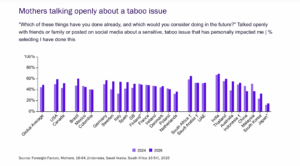
Brand communications are starting to reflect this shift. Eco diaper brand Peachies’ Blood, Sweat, Tears, Baby campaign used the launch of its size 00 newborn nappy to foreground the parents’ experience rather than just the baby’s. It depicts the messy reality of early parenthood in response to the brand’s own research, which revealed that 95% of surveyed UK mothers didn’t feel fully prepared for the physical reality of postpartum recovery. The campaign aims to focus on the practical support that parents need during the postpartum period such as meals, cleaning and laundry.
Meanwhile, some brands are moving from visibility into advocacy. Supplement brand Perelel’s co-founder Alex Taylor has lobbied Congress to make postnatal vitamins HSA/FSA-eligible (meaning consumers can purchase them tax-free), highlighting postpartum care as an access and policy issue. This kind of founder-led advocacy reflects how brands can fill communication and innovation gaps left by underfunded maternal healthcare systems.
Opportunities are opening across postpartum categories
Postpartum care is not just a medical or babycare concern. Brands are expanding products and services around the fourth trimester across categories, including five key subcategories that we’ve uncovered in our research, which fit broadly into: recover, restore, feed, rebuild and replenish.
Recover: Making physical recovery more visible
Recovery products such as pads, underwear and pain relief are becoming more prominent, more premiumized and more accessible. Postpartum and pregnancy solutions brand Due’s expansion into 419 Priceline stores in Australia demonstrates how postnatal care is moving into mainstream visibility. Making products for concerns such as bleeding and soreness available in everyday retail helps to make postpartum recovery easier to recognize as a normal lifestage need, rather than something specialized or niche.
Feed: Reframing breastfeeding solutions around comfort
Feeding remains a high-pressure postpartum need, but innovation is focusing more on comfort and confidence rather than pure efficiency. Momcozy’s Breathe & Breastfeed initiative during World Breastfeeding Month across Southeast Asia combined the launch of the Wellness 1 Warm-Massage Wearable Breast Pump with expert-led education and community initiatives. The guidance focused on misconceptions and challenges, with the aim of offering emotional reassurance to mothers, while the pump was designed to improve comfort while pumping.
Restore: Making emotional support practical
Philips Avent’s Share the Care Connector, created with March of Dimes in the US, is an automated SMS-based tool that helps mothers activate their support network. Users can invite their “village”, specify the help they want, assign a “Most Valuable Villager” to coordinate support, as well as trigger requests for meals, errands and check-ins. The tool aims to reduce the load on new parents when asking for help and shine a light on the practical help most valuable to new parents.
Rebuild: Supporting postpartum fitness, strength and sleep
Traditional wellness and fitness brands are also moving into postpartum. Anytime Fitness India’s maternal wellness campaign framed return to movement around strength and wellbeing, supported by a week-long digital campaign and gym-based offers including a three-day free pass. This signals the entry of mainstream fitness into postpartum recovery, though appealing to new mothers will likely involve avoiding language that pressures them to “bounce back”.
Sleep technology is moving closer to this space too. Eight Sleep’s over-mattress Pod includes Pregnancy Mode, designed to support sleep from the first trimester through 24 weeks postpartum.
Replenish: Nutrition as post-birth recovery
Nutrition is another emerging opportunity. Nestlé Materna’s Expert Post-Birth Recovery supplements launched in China extend maternal nutrition support beyond pregnancy. They focus on recovery, energy levels and breastfeeding needs and helping mothers replenish for their own wellbeing and their baby’s health.
As postpartum care becomes more holistic, supplements, meal kits and functional products can play a larger role – provided they are positioned as recovery and nourishment rather than another optimization burden placed on mothers.
Quick answers to what consumers are asking about postpartum care
Q: What is the “fourth trimester,” and why is it getting so much attention?
A: The fourth trimester refers to the twelve weeks following childbirth, a period increasingly recognized as a distinct lifestage rather than simply an extension of infant care. High-profile cases and rising rates of postpartum depression and psychosis have pushed this period into the spotlight, with brands and healthcare systems, including the NHS, now building dedicated support around it.
Q: Why are brands investing in postpartum recovery products right now?
A: Consumer demand for validation and practical support during postpartum recovery is rising, and destigmatization is widening the conversation. Brands are responding across five categories: recover, feed, restore, rebuild and replenish, from pharmacy-aisle recovery products to SMS-based support networks and postnatal nutrition, provided the positioning centers on genuine care rather than pressure to “bounce back.”
Why it matters
- Like much of women’s health, postpartum care remains underfunded and under-researched – for example a report from the UK’s National Childbirth Trust found that the postnatal care system was “dangerously underfunded and understaffed”. Entrenched inequalities exist among women too, for example, women of color in the US experience higher rates of maternal complications. While commercial innovation from brands can bolster emotional and practical support for mothers, advocacy for systemic responsibility and access is also sorely needed.
- Healthcare systems are beginning to acknowledge the need for more consistent support. The NHS postnatal care toolkit, launched in early 2026, points to growing institutional recognition that postnatal care needs clearer standards and better coordination. And in India, Manipal Hospitals’ MomStory initiative brings maternity and broader women’s health services under one platform, including postpartum care, signaling a shift towards more integrated support.
2. Back to school…without phones. What should fill the void?

Smartphone bans have gone global
In much of the world, September marks back-to-school season. And this year, the majority of students will be heading back to a phoneless campus. At a global level, 58% of countries now enforce national bans or restrictions on mobile phones in schools – up from 24% in June 2023. In the US alone, bans are in effect in at least 39 states plus Washington, D.C.
What replaces the click and swipe?
While the jury is still out as to how effective these bans really are when it comes to improving academic performance and mental wellbeing, there’s no denying that they will have a marked impact on how young people spend their time. In the UK, it’s estimated that one in five children spends at least seven hours a day using phones and tablets. Similar research in the US suggests students spend around 5 hours on their phones per day on average. Removing smartphones from the school day – not to mention enacting wider social media and smartphone bans at a national level – begs the question: how should kids spend their time instead?
This is a gap that children and teens themselves recognize. One New York student told the Guardian that she received her first iPad when she was in kindergarten (age 5). She said: “We were the first generation to grow up on technology. If legislators are implementing these phone bans, we need to take into account: what are the substitutes? Most kids my age have a relationship with technology, so there has to be other alternatives to replace it.”
Finding a balance between digital and analog
For some, the solution lies in providing easy access to tactile, hands-on activities that engage the senses – like crafting and mending. One school has introduced rolling “craft carts” around campus for use during and after the school day. Another school is opening up a “detox room” with stress toys and books, and yet another has set up a phone-free scavenger hunt involving disposable cameras.

Activities like these that require time away from screens are increasingly associated with positive mental wellbeing effects. Indeed, 65% of consumers globally agree with the statement “I find activities that involve using my hands to be soothing” (source: Foresight Factory, 2025). Perhaps this helps to explain why squishy toys and fuzzy notebooks are at the top of some tweens’ back-to-school wishlists this year.
Meanwhile, a group of students in California have co-authored a new “digital wellness” bill that would require schools to actively teach students how to have a healthy relationship with technology. “We’re not anti-tech,”one of the students told Edsource. “We’re for education, and we have to be balanced with technology, because it can be good and also inescapable.”
 While craft carts at school can help fill the smartphone void, that’s not the only reason hands-on workshops and mending services are experiencing a boom; there’s also a financial – and self-sufficiency – angle at play. And these are motivations that brands are increasingly tapping into. Uniqlo, Levi’s and Zara are just some of the companies that have introduced in-store repairs, sewing workshops and skills-building events aimed at younger consumers. As thrifting and resale continue to grow among this audience, these kinds of activities can empower them to extend the lifespans of the things they buy – essentially, getting more bang for their buck.
Back-to-school season is also arriving at a time when budgets are acutely squeezed, with 45% of US households reportedly planning to use buy now, pay later to fund back-to-school purchases. This makes mending and repair services doubly appealing to kids and parents alike, since it means they don’t need to buy more things. Certain BTS buys are especially pricy this year because of geopolitical factors; petroleum-derived products like shoes, for example, have increased in price due to trade policies and the Iran war. With children typically outgrowing footwear every few months, the outlay for parents is significant.
Attending workshops and taking up new hobbies have the added benefit of introducing consumers to new communities of like-minded people. At a time when loneliness and social isolation are top-of-mind concerns for younger generations, it’s no wonder these sorts of activities are finding new relevance.There is, of course, the risk that encouraging young people to take up more hobbies will only add to the pressure they already feel to optimize their leisure time and squeeze value out of every minute they have. A widely shared TIME article on the topic highlights how “we have turned hobbies from optional leisure activities into a marker of identity. Somewhere along the way, hobbies have become another thing to perform. We are confusing leisure with achievement.”
Quick answers about what brands need to know about school phone bans
Q: How many schools have banned phones, and where?
A: 58% of countries now enforce national restrictions on mobile phones in schools, up from 24% in June 2023. In the US, bans are in effect in at least 39 states plus Washington, D.C., making this one of the fastest-spreading education policies of the year.
Q: What activities are replacing smartphones during the school day?
A: Schools and brands are turning to tactile, screen-free alternatives such as craft carts, detox rooms with stress toys, disposable-camera scavenger hunts and in-store repair or sewing workshops from retailers including Uniqlo, Levi’s and Zara. These activities also appeal on financial grounds, helping budget-conscious families extend the life of what they already own.
Why it matters
- Deep reading, book clubs, run clubs and “slow hobbies” are just some of the activities that young people are gravitating toward as they contend with social media and phone bans – not to mention the general feeling that technology has a negative impact on wellbeing. Brands can play a role here by facilitating group activities that help young people build new skills, experience a sense of satisfaction and form meaningful social connections. But be wary of turning leisure into yet another source of pressure; the opportunity lies in allowing young people to disconnect and participate without the expectation of performance or optimization.
- As the cost of living continues to bite, there are also opportunities to emphasize the practical benefits of repairing and extending the lifecycle of products. Workshops, mending services and other hands-on experiences can help young consumers stretch their budgets and foster self-sufficiency in a world where resilience against disruption and resource scarcity is becoming an increasingly important life skill to master.
3. Let’s get whimsical: Mystery and whimsy as an antidote to the ordinary
Whimsy is having a moment
The internet’s latest cultural fixation is “being whimsical”. Google searches for “whimsy” have been rising, while #whimsy and #whimsical are tagged against hundreds of thousands of TikTok posts, and Etsy has reported searches for whimsical jewellery, décor and related items are up by at least 50% year-on-year. Part of the appeal for consumers is that whimsy makes ordinary life feel less ordinary. Being whimsical offers them a way of injecting lightness, spontaneity and a sense of play back into lives that can otherwise feel mundane – whether that means adding a quirky object to their homes, bedazzling their phones and birthday cakes with rhinestones, or using a magic wand to make payments.
At its heart, whimsy is about bringing unpredictability and playfulness to everyday lives that were starting to feel mundane and routine. We’ve flagged this instinct before, most recently in April with the rise of side quests – small, self-directed detours people have started building into ordinary days to make life feel less scripted.But the latest iteration of this impulse is increasingly about the element of surprise and mystery. When feeds, shopping recommendations and even travel itineraries are designed to anticipate what consumers want, there is growing appeal in handing over some control and not knowing exactly what comes next.
Brands are getting in on the mystery
Brands are finding increasingly imaginative ways to infuse mystery into the purchase journey.
In beauty, Harry Styles’Pleasing offers mystery bundles in “cozy”, “hot” and “fancy” editions, framing the experience as an “adventure”. CharlotteTilbury has similarly embraced mystery boxes, while Gisou’sHoneyPups paired a lip mask with a randomly selected bag charm, with the limited-edition drop selling out almost immediately.
But the format is moving beyond products. Mystery travel asks consumers to give up control of the destination altogether, replacing the certainty of choosing with the thrill of finding out. Groupon’sMysteryGetaway, for example, offers a flight-and-hotel package to an undisclosed destination for as little as $199. In the ongoing cost of living crisis, this pricing along with consumers’ growing penchant for gambling makes taking a mystery vacation all the more appealing.
The same cost-effectiveness is flagged by consumers who have purchased Harry Styles’ mystery boxes. One user on Reddit said “it’s worth the gamble. It was SO fun to unbox!! I ended up getting $600 worth of products for only $200”. On TikTok, another user said it was the “best $100 I’ve spent in a while” suggesting the format is landing as a genuine bargain as much as a novelty.
Even breakfast occasions are getting a whimsical upgrade. In April, Kellogg’s brought physical toys back to cereal boxes for the first time in over a decade, tying the relaunch to Disney and Pixar’s Toy Story 5. The framing leaned directly into the whimsy narrative: with screens dominating childhood, the campaign positioned a physical toy inside a cereal box as a way to recreate the “timeless magic” of a surprise-driven breakfast ritual.
Is it whimsy – or is it capitalism?
Some have identified an irony at the heart of the whimsy revival: the desire to escape what’s seen as an increasingly commercialized, optimized world is itself becoming commercialized. Indeed, critics on social media argue that some consumers are approaching whimsy the wrong way by turning it into a shopping list. In their minds, genuine whimsy shouldn’t require a purchase at all. Others call out the negative environmental harm of performative whimsical items like rhinestones, with one Instagram user referring to them as “chunks of discarded plastic being used as props”.
Why it matters
- The appetite for mystery isn’t new. Blind boxes, lucky bags, mystery grab-bags and cereal-box prizes have existed for decades, and 62% of consumers are interested in mystery surprise product purchases – a figure that has remained unchanged since 2023 (ForesightFactory, 2026). What is changing is the cultural context. As AI and algorithms become increasingly good at predicting what consumers want, hyper-personalized experiences become easier to access. Mystery offers the opposite: an opportunity to give up control and encounter something that wasn’t chosen, personalized or recommended for them. Moreover, in a world characterized by rising uncertainty and an ongoing permacrisis, there is growing value in experiences that feel unnecessary, unpredictable and even a little irrational. The appeal isn’t always the product itself, but the anticipation that comes before it.
- For brands, this creates an opportunity to create genuine moments of surprise rather than simply turning whimsy into another aesthetic to consume. The opportunity therefore extends beyond mystery boxes. From surprise menus and unexpected collaborations to secret events, unannounced rewards and serendipitous experiences, brands can build moments where consumers experience novelty across everyday interactions.
Talk to us about getting access to Collision, our dynamic trends intelligence platform
These September 2026 trends are part of a longer report published on Collision, Foresight Factory’s dynamic trends intelligence platform. Members get access to these reports at the beginning of every month, so they always have a finger on the pulse of consumers and culture. If you’re interested in learning more about Collision and how the platform can make a difference to your business, get in touch today.