Editor’s note: Strategic foresight is valued but underpowered because few organizations clearly own it or can prove its ROI. Foresight Factory research shows 85% rate it strategically important, yet only 15% have a dedicated foresight function.
What is the state of strategic foresight in 2026?
Foresight has never been more valued, or more vulnerable. In 2026, foresight practitioners overwhelmingly say it matters to strategy, yet few organizations clearly own it or can prove what it returns. That gap, between how much strategic foresight is valued and how little it is embedded, is the defining challenge for the practice today.
Over the past 30 years, Foresight Factory has been at the frontline of its evolution. Our new report, Who owns the future? The state of foresight today, brings together the views of experts around the world working across insights, strategy, innovation, foresight and marketing functions, offering a cross-sector perspective on the current state of foresight, how it is applied today and where it could go next.
Two findings speak to how much foresight is valued:
- 85% say it is at least moderately strategically important, and its reach is already broad
- 6 strategic disciplines are influenced by foresight, each cited by at least 40% of respondents
But three speak to how little it is embedded:
- Only 12% describe their organization as highly proactive
- Only 15% have a dedicated foresight function
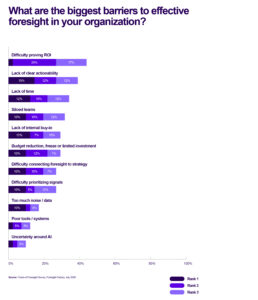
- 44% place difficulty proving ROI among their top three barriers to effective foresight
The pattern is consistent: foresight is strategically valued but organizationally underpowered. This report explores what needs to change if foresight is to move from a valued practice to an owned strategic capability. It identifies five themes that point to where it must go to prove its worth and put a number on it.
What does foresight mean to practitioners today? In their own words
Here’s how foresight practitioners themselves describe the work. Asked what foresight means in their role today, respondents returned strikingly varied answers. That variety is a sign of both the breadth of the practice and the ambiguity this report sets out to address.
- “The ability to see past tomorrow and create things that will set us up for future success.”
- “Using what we know about the external environment now, politically, socially, economically, and trends in these areas, to anticipate what our operating environment will look like in 10, 30, 50 years’ time, and understand where we might need to adapt, change, grow or retract.”
- “Planning for the future, not to predict it but to set up brands for their best future by identifying growth opportunities and potential threats.”
- “Creating a shared understanding of cultural, market and consumer changes that could impact our categories, brands and business, in a way that drives strategic decision-making.”
- “Helping the organization understand and prepare for multiple potential future realities based on both macro forces and rapidly evolving human trends.”
- “Foresight is about navigating uncertainty and designing the future we want to inhabit.”
1. Who owns the future? Which teams own strategic foresight today?
Foresight isn’t being rejected; it’s being dispersed.
We all know that foresight needs dedicated space to deliver value. But for many organizations, foresight ownership is unclear. While 59% of respondents told us their Insights team owns foresight, 46% said Strategy and 17% said Innovation. Only 15% have a dedicated foresight team, and one in ten say there is no formal ownership at all. Meanwhile, 63% of companies have seen their foresight function undergo structural change in the past 12 months. When a function sits across so many teams, accountability becomes messy. In turn, the ROI of foresight becomes harder to prove, and foresight risks becoming underpowered and unable to effect real change. When no one clearly owns the future, foresight struggles to influence budgets, prioritization and the decisions that matter.

Thought starter: When a function sits across multiple teams, accountability becomes messy. So where does foresight sit? The full report breaks down which teams own it today, and how many organizations have no formal ownership at all.
2. Would your foresight survive the boardroom? How can foresight prove its value to leaders?
Foresight earns its place when it shapes decisions.
The last thing leaders need is more information. Foresight was once seen mainly as tracking and gathering insights, but its role has moved on. Today, leaders are looking for strategic decision-making guidance, expert interpretation and the confidence to act decisively.
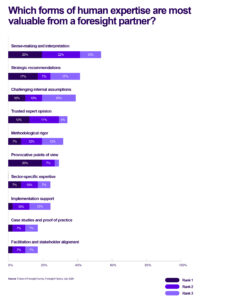
This need bears out in our research. Respondents told us that a lack of clear actionability and a lack of time are the top two barriers to effective foresight in their organizations. Sitting underneath this is the constant pressure to prove value and financial impact. Difficulty proving foresight ROI is the most commonly cited secondary barrier, even though few name it as their single top one. Meanwhile, the two most valued forms of human expertise respondents want in a foresight partner are sense-making and interpretation, along with strategic recommendations.
Looking ahead, the capability expected to grow most in importance over the next three years is the ability to translate uncertainty into clear, commercially relevant action. That is the real test: would this survive the boardroom? In a world flooded with information, strategic foresight’s value will be judged not by the quality of its insights, but by the quality of the decisions it helps leaders make.
Thought starter: If leaders want decisions, not more data, how does your foresight measure up? The full report reveals the top barriers to effective foresight and the capabilities practitioners expect to matter most over the next three years.
Strategic foresight FAQs
Q: Who owns strategic foresight in most organizations?
A: Ownership is fragmented. 59% of respondents say their Insights team owns foresight, 46% say Strategy and 17% say Innovation. Only 15% have a dedicated foresight team, and one in ten have no formal ownership at all.
Q: How important is strategic foresight to organizations today?
A: Highly valued but under-embedded. 85% of practitioners say foresight is at least moderately strategically important, yet only 12% describe their organization as highly proactive.
Q: What are the biggest barriers to effective foresight?
A: A lack of clear actionability and a lack of time are the top two barriers. Difficulty proving ROI is the most commonly cited secondary barrier, and 44% place it in their top three.
Q: How can foresight teams prove ROI to leadership?
A: By shaping decisions, not adding information. Practitioners expect the ability to translate uncertainty into clear, commercially relevant action to grow most in importance over the next three years. Foresight will be judged by the quality of the decisions it helps leaders make.
What comes next for strategic foresight?
Our full report closes with where foresight stands today, and where practitioners expect to grow it next. It also sets out the Foresight Factory answer to the question we began with, “Who owns the future?”, along with five provocations to take back to your organization.
Click here to download Who owns the future? The state of foresight today to read the full findings.